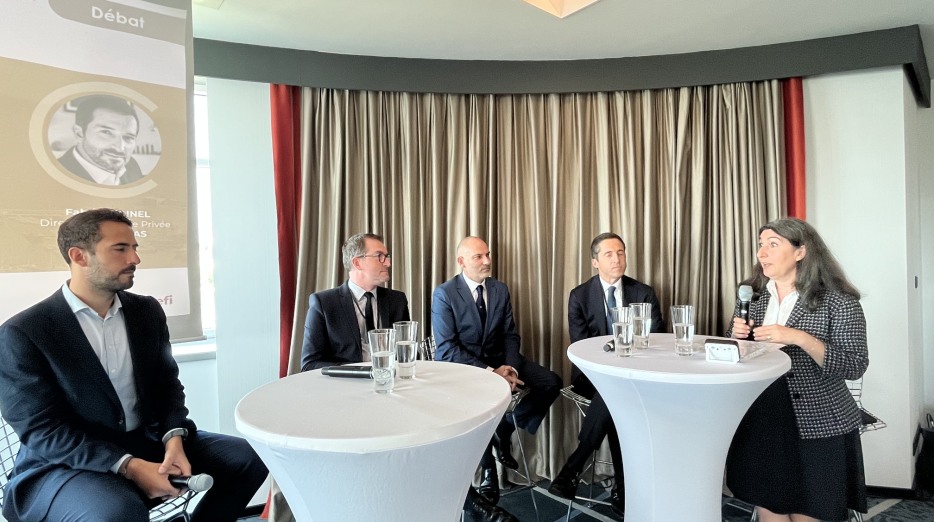
Moderated by Catherine Rekik, editor-in-chief of Wealth and Private Banking at L’AGEFI, this roundtable brought together Thomas Lhuillier, CEO of Banque Richelieu Monaco, Fabrice Toinel, Head of Private Banking at BNP Paribas; Guillaume Martin Saudax, Head of Wealth Engineering at Edmond de Rothschild Monaco; and Sébastien Champion, Head of Intermediaries at Swissquote Bank Europe SA. Together, they offered a clear assessment: wealth and business succession is now a major issue, where human, international, and intergenerational factors have come to take precedence over purely technical considerations.
Wealth and business succession is now one of the major challenges facing private wealth management. Long approached primarily from a legal or tax perspective, it has now emerged as an economic, human, and strategic issue. Professionals note that many business leaders have still not prepared their succession plans. In France, nearly one in two business leaders aged 60 to 69 has not yet prepared their succession plan, and 76% of family-owned businesses have not yet structured their governance. This delay can lead to a loss of value, undermine the long-term viability of businesses, and put several million jobs at risk. In Monaco, this issue takes on an additional dimension. The Principality’s appeal attracts international families whose assets often span multiple jurisdictions. While Monegasque civil law remains similar to French law in certain respects, the tax differences are significant. For example, inheritance taxes can reach 45% for direct descendants in France, whereas they are often nonexistent in Monaco. Wealth transfer can therefore no longer be considered on the scale of a single jurisdiction.
This internationalization is profoundly transforming the field of wealth planning. Specialists no longer seek to master all global legislation, a task that has become impossible given the proliferation of regulations. Their mission now consists of identifying the specific challenges facing each family and coordinating the necessary expertise across the various jurisdictions involved. Each case must take into account the specificities of local laws—and sometimes even religious inheritance rules—to ensure the consistency of the chosen arrangements. This tailored approach turns the advisor into a true orchestrator. There is no one-size-fits-all solution, but rather solutions tailored to each family, its history, its assets, and its international presence.
All professionals agree on one point: the difficulties encountered during a succession are rarely technical in nature. They are far more often rooted in a lack of dialogue, a failure to plan ahead, or divergent expectations between generations. A successful succession is generally prepared ten to fifteen years before it is finalized. Preparing for a succession therefore requires initiating in-depth work with the entire family well in advance. This involves gradually guiding the future heirs, structuring governance, organizing gifts where appropriate, and, above all, opening a dialogue on sometimes sensitive topics such as long-term care, death, the sharing of responsibilities, or the future of the business. Financial institutions now support the family as a whole, rather than just the wealth holder. This shift is accompanied by the emergence of a new generation of heirs—one that is more international, better informed, and has different expectations. People today become wealthy earlier, but they often inherit later—sometimes even skipping a generation. More attuned to sustainable investments, private assets, cryptoassets, and the societal impact of investments, this generation expects a more personalized, digital relationship that is focused on support rather than solely on financial performance.
Beyond legal structures or tax strategies, the success of a wealth transfer depends above all on the ability to bring a family vision to life. Financial institutions are now developing programs dedicated to the new generations, including mentoring initiatives, “Next Gen” meetings, financial education initiatives, and training designed to prepare for the handover. Professionals also highlight the emergence of new family mediation roles designed to facilitate dialogue between generations. Finally, philanthropy is emerging as a powerful factor in family cohesion. Because it enables the sharing of a common vision, the transmission of values, and the empowerment of future generations, it is establishing itself as a major driver of wealth management strategies. At a time when wealth is becoming increasingly globalized and estate planning is growing ever more complex, wealth transfer is no longer merely a matter of transferring assets: it is a long-term endeavor based on foresight, dialogue, and the desire to sustain family harmony over the long term.