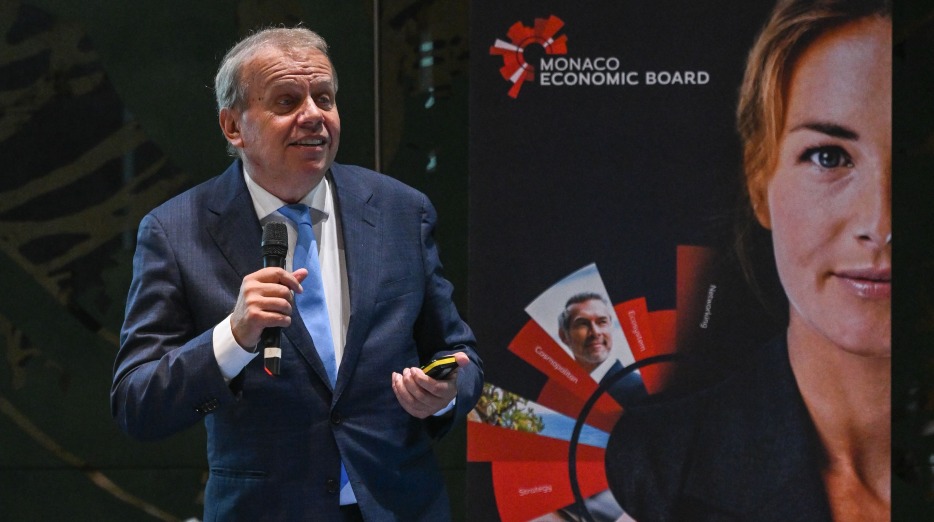
At the invitation of the Monaco Economic Board, in partnership with Jutheau Husson, Jean-Pierre Petit, president of Cahiers Verts de l’Économie, delivered an uncompromising analysis of the major geopolitical, economic and financial upheavals in Monaco.
For Jean-Pierre Petit, the shift in the geopolitical landscape is nothing new. In his view, 11 September 2001 marks one of the major turning points of our time. Since then, international conflict has continued to escalate, accompanied by a rise in military spending and a succession of crises – from Georgia to Crimea, and on to more recent conflicts.
But this shift extends beyond the military sphere alone. Rivalry between major powers, competition for strategic resources, the weakening of multilateralism and China’s rise to power: the world has entered a phase of much more widespread confrontation. Cyberattacks, disinformation, sabotage, commercial or energy-related pressure, the exploitation of migration and the growing use of drones are now broadening the spectrum of risks.
For financial players, the consequence is clear: geopolitical risk can no longer be treated as an exceptional event. It is becoming a permanent factor in asset allocation, corporate finance and risk management.
Iran illustrates this new geography of risk. At the heart of the analysis lies the Strait of Hormuz, a nerve centre of the global hydrocarbons trade. Jean-Pierre Petit believes, however, that a distinction must be made between the dramatic impact of a crisis and its net economic effect. In his view, the capacity to divert flows via pipelines, strategic reserves and the potential to redirect trade flows would limit the actual disruption to around 5 per cent of global oil production.
In this scenario, he considers a barrel price ranging between $85 and $100 to be consistent with the tensions observed, although temporary spikes to higher levels remain possible. He also anticipates a resumption of negotiations, without, however, envisaging a swift resolution: the region could see a prolonged cycle of alternating phases of tension and periods of de-escalation.
For the markets, the challenge is therefore less about predicting the disappearance of the risk than about learning to factor in its recurrence.
Another disruptive factor: the United States. With the mid-term elections approaching, Jean-Pierre Petit points out that US presidents frequently lose seats in mid-term elections. Predictive markets assign a high probability to the Democrats regaining control of the House of Representatives, whilst the Senate appears more uncertain.
However, in his view, institutional gridlock would not necessarily mean economic paralysis. Many US presidents have governed with a divided Congress. Above all, key areas – foreign policy, trade, immigration, regulation and presidential decrees – remain largely under the influence of the executive.
The main area of concern lies more on the bond side. With a federal deficit exceeding 6 per cent of GDP in the analysis presented, questions regarding the debt trajectory, the debt ceiling and the risk of a shutdown remain central. For investors, Washington therefore remains a source of volatility, but not necessarily an obstacle to the performance of risky assets.
It is on France that Jean-Pierre Petit’s assessment is most severe. In his view, the absolute level of debt matters less than its dynamics. In the scenario outlined, it could reach around 119 per cent of GDP and then approach 130 per cent by 2030 in the absence of any significant correction.
Low nominal growth, a persistent primary deficit and rising interest payments are fuelling an unfavourable spiral. The spread between French and German ten-year bond yields is, in this context, a closely watched indicator. Another weakness highlighted is that a significant proportion of the French deficit finances consumption rather than productive investment, in contrast to Germany’s focus on infrastructure and defence spending.
Jean-Pierre Petit nevertheless rejects overly hasty comparisons with the Greek crisis. France has a larger economy, substantial private savings, a significantly stronger external position and political and strategic clout that is in a league of its own.
The difficulties are more structural in nature: an ageing population, pension and healthcare expenditure, low potential growth, high levels of taxation, a falling birth rate, and funding requirements linked to energy, digital technology and defence. Added to this, in his view, are weaknesses in terms of human capital, labour force participation rates, automation, artificial intelligence and institutional efficiency.
His conclusion is a sobering one: without credible and sustainable adjustments to public spending, financial constraints could ultimately force through the very changes that the political system is currently struggling to implement.
This highly strained geopolitical and fiscal landscape does not, however, lead to a scenario of global recession. Global growth stands at around 3.5 per cent, driven in particular by the resilience of the United States.
The US economy is benefiting from high corporate profit margins, massive technological investment and, above all, significant productivity gains. Jean-Pierre Petit points to growth of close to 3 per cent over three years, which will help to contain unit labour costs despite rising wages. Against this backdrop, he does not believe there will be a sustained return to high inflation, barring a major energy shock.
US consumption also remains robust, although its continued strength will depend on the economy’s ability to sustain job creation.
In China, the picture is more mixed. Exports remain a powerful driver of growth, whilst the property market, consumer confidence and domestic consumption remain fragile. However, the technology sector is underpinning economic activity in Asia, with favourable trends also evident in Taiwan, South Korea and India. In Europe, an improvement is taking shape, particularly in Germany, whilst France appears to be lagging behind.
One of the most significant messages from the conference concerned long-term interest rates. According to Jean-Pierre Petit, their rise cannot be explained solely by inflation or by central bank decisions. It reflects a deeper transformation: the world needs considerable capital.
Artificial intelligence, digital infrastructure, the energy transition, defence and geopolitical realignment all simultaneously require massive investment. By way of illustration, he highlighted that major US technology groups had issued around $180 billion in debt from the start of the year until the beginning of the summer – more than double the total for the whole of 2025, according to the figures presented.
Added to these private-sector needs are US public deficits and an environment in which certain major foreign buyers of US debt are less active than before.
The result is a world characterised both by historically high levels of debt in peacetime and by real interest rates that are approaching, or even exceeding, the potential for real growth. This situation drives up the cost of capital and forces banks, investors and companies to reassess their financing decisions.
In the equity markets, Jean-Pierre Petit acknowledges high valuation levels and a spectacular concentration on US technology. However, he rejects a binary view of the issue of a bubble linked to artificial intelligence.
Financial history shows, he points out, that a bubble can last several years after the first warning signs. The 1920s and the period leading up to the bursting of the dot-com bubble illustrate this. His own bubble indicator stands at a high level, around 80 per cent, with several warning signs: the pace of initial public offerings, capital raising and analysts’ expectations, which are at times highly ambitious.
But the comparison with the late 1990s has its limitations. Today, investment in technology is accompanied by real productivity gains; debt is not widespread across the entire sector; and the market is making a clearer distinction between companies capable of financing their investments through their cash flows and those with a more fragile business model.
His stance therefore remains nuanced: broadly positive on equities in the medium term, but cautious in the short term. And, between the United States and Europe, his preference remains with the US, due to earnings momentum, technological leadership and an environment he considers more favourable.
Throughout this very broad analysis of the global economy, one idea stands out: the current upheavals are not merely a temporary blip. Geopolitics, sovereignty, artificial intelligence, financing needs, public debt and market volatility are combining to form a new, lasting environment.
For banks and investors, this transformation requires a rethinking of analytical frameworks. Geopolitical risk must be factored into models; the structural rise in capital requirements is altering the cost of funding; artificial intelligence is redistributing productivity gains; and the sustainability of public finances is once again becoming a key market variable.
In this context, the question is no longer when the world will return to its previous equilibrium. It is how companies, financial institutions and investors can build their strategies in a world where disruption itself is becoming the new normal.
And this is undoubtedly the key message delivered by Jean-Pierre Petit in Monaco: when faced with radical disruptions, the first mistake would be to wait for them to disappear.
Crédits : Sébastien Darrasse / MEB