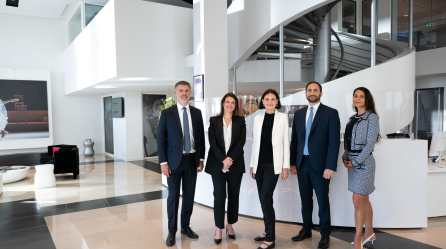
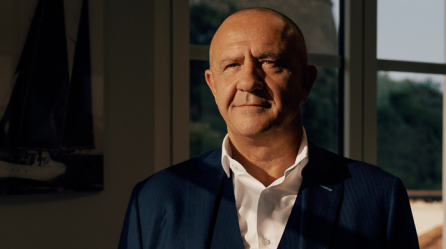
Laure Canas Da Silva, President of AMFID, the Monegasque Association for Sustainable Finance, and Head of Conduct Risk & Regulatory at EFG Bank, is observing developments in sustainable finance. Following the initial phase of raising awareness comes a period of structuring, training and regulatory requirements. In Monaco, AMFID aims to support this evolution by strengthening dialogue between professionals, experts and the next generation.
It has been a very positive year. The association is evolving and expanding with the arrival of new members on the executive committee. We remain a small organisation, but one with great ambition and, above all, many issues to address. This momentum should enable us to play a greater role in training, regulatory monitoring and, more broadly, in supporting the financial community. Founded in 2023, AMFID was built around very specific objectives: promoting a culture of sustainable finance, monitoring economic and legal developments, and creating forums for networking and training for ESG correspondents. We are now in the process of consolidating the work we have undertaken over the past three years.
One of the most memorable experiences was our collaboration with students on the IUM’s Bachelor’s degree programme, in particular with Grégory Moscato, Head of the Finance Department, and Alberta Savage, an English lecturer. We produced podcasts and conducted interviews with this new generation. We did not expect such enthusiasm. Some students even told us after these sessions that they had no idea just how rewarding and interesting ESG-related careers could be. These exchanges also enabled professionals to better understand the students’ expectations. This initiative is, in fact, a continuation of the awareness-raising work undertaken since the association’s inception, notably with the approval of a four-hour module dedicated to ESG criteria as part of the professional certification scheme.
A survey carried out within the financial sector had already highlighted a significant need for training, particularly amongst executives and senior management. This issue has now taken on an additional dimension with changes to the regulatory framework. It is therefore no longer just a matter of training new entrants: governing bodies are also directly affected.
In particular, the regulations strengthen the requirements regarding the training of members of management bodies on ESG risks and impacts, as well as on IT risks. They stipulate that organisations must allocate adequate human and financial resources to this. We have therefore entered a phase where simply raising awareness is no longer enough: institutions must genuinely integrate these issues into their governance and areas of expertise.
This is why AMFID wishes to play its full role in monitoring and providing support, by alerting its members to new obligations and putting them in touch with experts who can assist them. This is fully in line with one of our founding missions: to monitor Monegasque and foreign legislation relevant to our members and to transform this monitoring into information that is directly useful to professionals.
Our role is not to replace training organisations. However, we can identify key issues, alert our members to regulatory changes, bring together relevant expertise and create the conditions that enable institutions to move forward. This is particularly useful for organisations that do not always have all the necessary in-house resources to keep up with increasingly technical regulatory changes. We have already operated in this way on several issues, by organising conferences dedicated to regulatory changes and their indirect impacts in the Principality, or by participating in ESG training courses with the ACI. Our role is also to act as a bridge between the needs expressed by the financial centre and the specialists capable of addressing them.
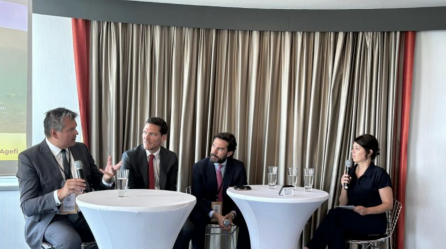
We are therefore organising a conference on 1 October, following our Extraordinary General Meeting, focusing in particular on regulatory monitoring, in collaboration with KPMG Monaco and experts able to share their insights. The primary aim is to raise awareness amongst senior management at member institutions of the new obligations, with the idea that this knowledge can then be passed on throughout the organisations and to their staff.
This is particularly important for smaller organisations, notably certain management companies, which do not necessarily have the same in-house resources as large groups. AMFID can specifically help to provide them with the tools to interpret these requirements and facilitate their access to specialist expertise. It is also in this spirit that we engage with the financial centre’s institutions. From the association’s earliest years, discussions have been held with the Prince’s Government and the CCAF, notably regarding sustainable finance standards, reputational risks and the consequences of greenwashing. These exchanges are important for staying closely attuned to the practical challenges faced by professionals.
Yes, because ESG is much broader. The environment is obviously an essential component, but we must also consider the social and governance dimensions. The social aspect, for example, covers very practical issues such as equality in the workplace. AMFID addressed this topic as early as 2023 at a conference organised by the International Hydrographic Organisation and also held discussions with the Principality’s Government regarding a proposed charter on gender equality.
Reputational risk is now fully integrated into risk assessments. This clearly demonstrates the extent to which ESG issues go far beyond the climate issue alone. In November 2025, we had already dedicated a conference to lessons learnt and to ESG from a reputational perspective, featuring speakers from Kepler Cheuvreux and Sqope Intelligence. Then, in April 2026, we continued this discussion, focusing on shipping, the Strait of Hormuz and ESG risks from a reputational perspective. It is precisely these intersections between finance, geopolitics, reputation and governance that demonstrate the breadth of the subject.
Sustainable finance has also become technically much more complex. To maintain a portfolio that meets ESG criteria whilst seeking strong performance, one must now track a considerable number of indicators. This poses a real challenge for professionals, who must balance ESG requirements, risk management and performance.
There is undoubtedly a move away from ESG, or at the very least, a re-evaluation in certain areas. The international context has changed and certain trade-offs have become much more complex. Debates surrounding sectors previously excluded from certain funds, such as the arms industry, clearly illustrate this development.
On the other hand, the current context should not be seen as a setback, but as a genuine opportunity for ESG. Recent tensions over oil supplies and the resulting rise in prices demonstrate, more than ever, the importance of energy independence. Reducing our dependence on imported fossil fuels is no longer merely a responsible choice. It has become a matter of sovereignty, which makes a direct case for the development of alternative energy sources.
We must also remain resolutely positive about the role of innovation. The rise of artificial intelligence, for example, requires considerable amounts of energy and will, in fact, accelerate investment in renewable energy. AI also opens up practical applications that promote sustainability. Examples include precision farming, which uses less water and fewer inputs, or more sophisticated management of electricity grids, capable of integrating more intermittent energy sources and minimising losses. This is precisely why it is important to involve experts: to identify the sectors and companies driving these fundamental transformations, beyond mere passing trends. Education and the quality of information therefore remain essential to enable investors to fully grasp these opportunities
We want to continue organising conferences, developing interviews and podcasts, revitalising our website and exploring new formats – perhaps even radio. We also wish to increase our presence at major industry events: AMFID is, in particular, planning to step up its participation in the Fund Forum and to continue its collaboration with L’AGEFI. Our aim is not to promote a specific product, but to foster a better understanding of what sustainable finance actually entails.
We also wish to strengthen collaborations with other players in the financial centre and continue our dialogue with Monegasque institutions. In particular, we have held discussions with Monaco’s International Cooperation Department to explore how we might contribute to some of its initiatives, particularly in Africa. The idea is to build more bridges and partnerships wherever they help to tangibly advance the understanding and practice of sustainable finance. This openness already exists: a meeting took place in December 2025 with the Prince’s Government’s Directorate of International Cooperation. We now want to explore how the expertise within AMFID can usefully contribute to concrete projects, whilst remaining within the association’s remit.
We wish to further develop AMFID’s international dimension and forge closer ties with foreign associations, particularly those in Switzerland. Sustainable finance obviously cannot be conceived of at the level of a single financial centre. Such partnerships would enable us to share experiences, best practices and developments observed in other markets. The next step is to give these relationships more substance, particularly with Switzerland, by identifying areas where regular exchanges would be of genuine benefit to our members.
Ultimately, our ambition remains very pragmatic: to build bridges, share expertise and support professionals as they navigate issues that are becoming increasingly technical, regulated and strategic.