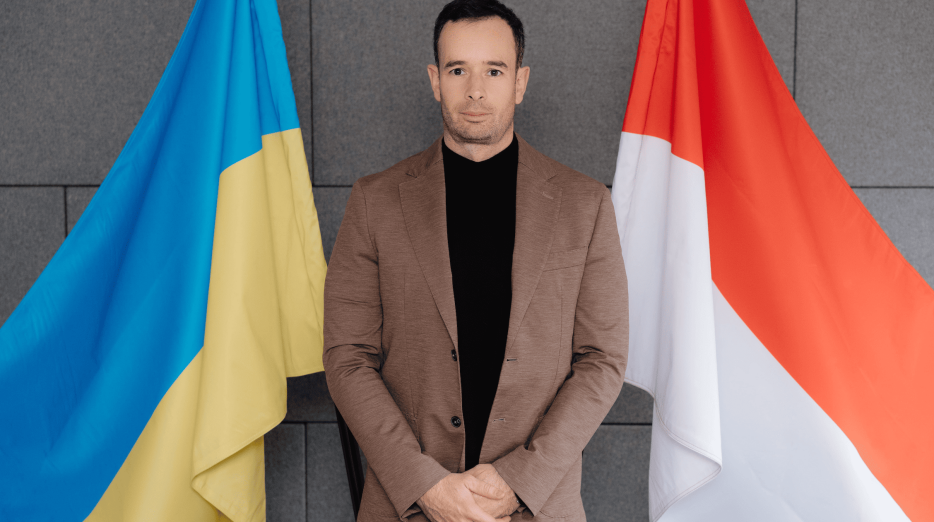
Appointed Honorary Consul of Ukraine in Monaco by sovereign order in January 2026, Alexandre Caracchini is an entrepreneur and civil engineer, CEO of RED WHITE GROUP. Active in real estate and infrastructure projects, he now provides Ukrainians with a wide range of assistance, often of an administrative nature. His conviction is that the reconstruction of the country will not begin after the war, but has already begun.
Today, there are approximately 319 Ukrainians living in the Principality. There was a significant wave of immigration four years ago, at the very beginning of the conflict, but Monaco remains a demanding place, both in terms of the cost of living and the regulatory environment. Many were unable to stay. Those who are now settled here are mainly entrepreneurs, established families, or highly skilled professionals.
Children integrate very well. They learn quickly, adapt quickly, and families also come here seeking security, stability, and the quality of the school system. We see a community coming together, not only among Ukrainians, but also with spouses, mixed families, and people who feel close to Ukraine. That’s why we wanted to create an open association: Les Amis de l’Ukraine (Friends of Ukraine), to help those in need.
Even in Kiev, which is far from the front line, the war is omnipresent. There is a strict curfew from midnight, numerous roadblocks, a very visible military presence, and the scars of the early days of the conflict are still there. We are also seeing more and more war wounded, amputations, lives marked forever. With each trip, this burden becomes heavier.
The country continues to function, but under constant tension. Electricity is not always guaranteed, which is why I now stay almost exclusively in hotels equipped with generators. In these hotels, I meet a lot of foreign investors, particularly Americans, and increasingly Koreans, who are very involved in infrastructure projects.
They are showing impressive resilience. They are working, moving forward, and preparing for the future. But some sectors have been hit very hard, particularly construction. Many workers have been mobilized on the front lines, and there will clearly be a labor shortage after the war, between the human losses and the people who have settled elsewhere and may not necessarily return to the country.
Reconstruction will not only be material. It will also be psychological. There is and will continue to be a huge need for trauma support. This is a subject that is rarely discussed, but one that will weigh heavily on the country in the years to come.
This is also why I am relying on very concrete initiatives led from Monaco. I am thinking in particular of the Dopomogator foundation, created by a Monegasque resident, which is working directly on the ground in Ukraine. Among other things, this foundation provides free bionic prostheses to civilians and veterans who have suffered amputations. To date, 26 high-tech prostheses have already been delivered. This is a very telling example of targeted, traceable actions with an immediate human impact.
The top priority is energy. Without energy, there is nothing: no hospitals, no water, no heating, no economic activity. Energy infrastructure is regularly targeted. Some nights have seen more than 400 drones and dozens of missiles deployed. At times, up to 800,000 residents of Kyiv have been simultaneously deprived of electricity and heating.
Needs also extend to transport infrastructure, housing, agriculture, logistics, and digitalization. Ukraine is very advanced in technology, and digitalization is a major lever for reconstruction. Even at war, it remains an extremely dynamic country in these areas.
Because reconstruction has already begun. Joint estimates by the World Bank, the European Commission, and the United Nations put the needs at more than $400 billion over the next decade. But every month of delay increases the future bill. Maintaining critical infrastructure today prevents much greater economic destruction tomorrow.
Yes, and this is a fundamental point. There are now funds that are structured, audited, and governed according to European standards: Amber Dragon Ukraine Infrastructure Fund, Horizon Capital Catalyst Fund, Rebuild Ukraine Fund, European Investment Bank programs, and the Ukraine Energy Support Fund. We are no longer in a situation of improvised donations, but in a structured financial architecture.
This is a legitimate concern. Today, multilateral funds and European institutions require enhanced due diligence, clear governance, detailed reporting, and independent audits. Major international firms are present on the ground. These mechanisms greatly reduce operational risk and ensure the traceability of capital. Investors can act effectively, compliantly, and securely, with traceable commitments and measurable impact. Reconstruction is already an economic reality. Supporting Ukraine today means combining performance, responsibility, and a strategic European vision.