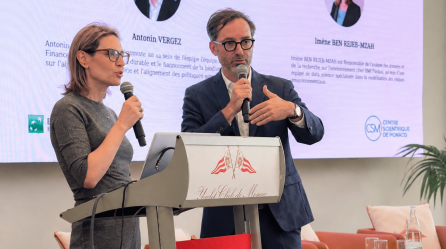
As it approaches its tenth edition, the Monaco Ocean Protection Challenge (MOPC) is establishing itself as an international initiative for identifying and supporting entrepreneurial projects dedicated to ocean conservation. Marine Jacq-Pietri, coordinator of the Monaco Ocean Protection Challenge; Sophie de Lorenzo, Director of Corporate Relations at the International University of Monaco (IUM); Andrea Delorenzi, Ocean Investment Analyst; and Laure Canas da Silva, President of the Monegasque Association for Sustainable Finance, discuss the competition’s ambitions and the challenges of financing the blue economy.
Marine Jacq-Pietri: The Monaco Ocean Protection Challenge, which will celebrate its tenth anniversary in 2027, is co-organised by four Monegasque institutions: the International University of Monaco, the Prince Albert II of Monaco Foundation, the Oceanographic Institute, and Monaco Impact, the association behind this initiative. We have also taken steps to establish the Challenge as a separate association.
Our aim is to identify, on an international scale, early-stage entrepreneurial projects with the potential to have a positive impact on the ocean. These may include business concepts developed by students or projects led by start-ups that have been in existence for less than three years.
Every year, we invite the selected teams to Monaco for the grand final. Beyond the financial prizes and support services awarded to the winners, our aim is to embed them long-term within a particularly rich ecosystem comprising experts, entrepreneurs, institutions and economic stakeholders committed to preserving the ocean.
When these project leaders join us, their businesses sometimes do not yet exist. The challenge lies in giving them the means to realise their ambitions and to draw on the network they have built up in the Principality throughout their development. We want to see genuine entrepreneurial success stories emerge.
Sophie de Lorenzo: Initially, our focus was mainly on how to raise awareness amongst younger generations about the challenges of ocean conservation. We organised an internal competition at the IUM, inviting our students to devise new ways of communicating with their own generation. Some particularly interesting approaches emerged, notably centred on gamification.
However, it became clear to us that we could go much further. To generate a tangible and lasting impact, setting up a business proved to be a particularly effective approach. In 2019, we therefore decided to give this competition an international dimension, and the first edition in this format took place in 2020. Despite an unfavourable health situation, we pressed ahead with this initiative, which really took off from 2022 onwards.
Today, the Monaco Ocean Protection Challenge plays a key role in integrating ocean-related issues into our discourse and our educational approach.
We are a business school. Nevertheless, it is our responsibility to demonstrate to our students just how important environmental issues are. When we discuss tourism, yachting or energy, the issue of the ocean and its conservation naturally comes to the fore.
Every year, groups of students spontaneously form around projects. Not all of these will necessarily lead to the creation of a business, but they demonstrate a growing awareness which, from an educational perspective, is already a real success.
Marine Jacq-Pietri: The increase in the number of applications is particularly encouraging. The 2026 edition received 215 projects, compared with 135 in the previous edition, with applications coming from around sixty countries.
Our selection process is rigorous. Several stages of assessment enable us to progressively refine our analysis of the applications before selecting the projects invited to Monaco.
We do not impose any specific sectoral restrictions, provided the project meets our fundamental criterion: to have a positive impact on the ocean. Nor do we set a strict age limit for entrepreneurs. What interests us is the level of maturity of their business, which must be less than three years old.
This openness allows us to welcome an extremely diverse range of proposals, encompassing technological innovations as well as new industrial processes and new business models.
Applications for the tenth edition have just opened, and we hope to once again far exceed the 200-project mark.
Sophie de Lorenzo: This is precisely one of the key challenges of our approach. As a business school, we have expertise in entrepreneurship, the analysis of business models and the assessment of the various stages of a company’s development. We also work with business incubators.
Assessing the viability of a business model, its development strategy or its growth prospects therefore falls within our area of expertise.
However, assessing the actual impact of a solution on marine ecosystems requires specific expertise. It is in this area that we wish to make further progress, and where the synergy with the Prince Albert II of Monaco Foundation and its ecosystem comes into its own.
Andrea Delorenzi: First of all, it is important to distinguish between the different stages of maturity of the companies. The ReOcean Fund is primarily aimed at companies that have reached a more advanced stage of development and are already generating a certain level of turnover.
The projects presented as part of the Monaco Ocean Protection Challenge are generally at a much earlier stage along this trajectory. We can, however, provide them with expertise that complements that of the International University of Monaco, particularly on issues relating to environmental impact. How can this impact be objectively measured? How can it be measured, and how can we ensure that the company’s governance and management enable it to maximise this impact throughout its development? How can we identify and manage the environmental, social and governance risks to which it may be exposed? These are issues we address as part of our investment activity and on which we could, in due course, share our expertise with the Challenge’s entrants.
The Prince Albert II of Monaco Foundation is also involved in strategic planning for the long-term development of the MOPC, as well as in organising the events that mark each edition.
Andrea Delorenzi: The aim is to build a project whose management and governance structures are, from the outset, geared towards maximising impact, whilst ensuring that ESG risks are kept under control. It is therefore not merely a matter of recognising that an innovation has environmental benefits, but of considering how the company can realise and sustain that impact as it grows.
Sophie de Lorenzo: The Foundation also gives us access to a particularly valuable international network, comprising higher education institutions, experts and stakeholders involved in entrepreneurial initiatives in support of the ocean. This openness helps to enrich our approach and place the Monaco Ocean Protection Challenge within a much broader ecosystem.
Sophie de Lorenzo: The Monaco Ocean Protection Challenge is, in a way, the entry point into this entrepreneurial ecosystem. We identify projects at a very early stage of their development. The Blue Economy and Finance Forum, on the other hand, enables us to meet companies that have progressed through several stages of their growth, as well as the financial stakeholders supporting them.
The Challenge’s finalists have the opportunity to be invited to the BEFF. I believe this is a particularly valuable opportunity: it enables them to learn about the trajectories of more mature companies, to meet investors and to gain a better understanding of the various stages that will mark their own development.
There is therefore a genuine synergy between these Monegasque initiatives, from the emergence of an entrepreneurial concept right through to its large-scale roll-out.
Marine Jacq-Pietri: Initial discussions with the Monegasque Association of Financial Activities have helped to identify a common area of focus centred on sustainable finance and, more specifically, impact investing. We are therefore working with AMFid.
To mark our tenth anniversary, we wish to offer participants an enhanced programme spread over two days. The day on 9 June 2027 could, in particular, feature workshops or round-table discussions addressing these topics. The format is yet to be finalised, but it would be particularly valuable to facilitate dialogue between young entrepreneurs and professionals in the field of impact investing.
Stakeholders in this sector have diverse backgrounds and approaches, and gaining insight into these could be invaluable for our candidates. It is this synergy that we wish to build upon. Applications are open until 31 January 2027. Project leaders can submit their applications directly via our website, using a new dedicated platform.
To mark this tenth anniversary, H.S.H. Prince Albert II of Monaco will honour us with his presence at the awards ceremony.
Laure Canas da Silva: The MOPC’s approach aligns perfectly with AMFiD’s guiding principles, which place particular emphasis on future generations. Involving students in ESG (Environmental, Social and Governance) initiatives is now firmly established within the Association’s work, as evidenced in particular by collaborations with the IUM: conferences, training courses, podcasts, etc.
AMFiD welcomes this partnership with MOPC and fully supports this project, which promotes environmental protection, ESG risk management and innovation. We are in discussions with MOPC to develop a support programme for the finalists, so as to ensure this partnership runs as smoothly as possible.