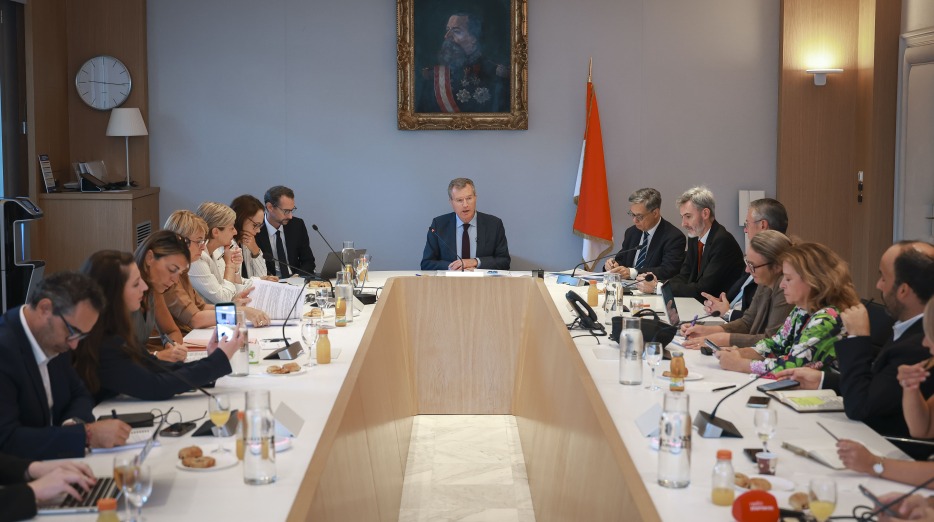
At its autumn briefing on Thursday 17 September, the Prince’s Government outlined the key issues that will shape the coming months in the Principality. Housing for Monegasques, security and facial recognition, the modernisation of the Fontvieille Shopping Centre, economic attractiveness and international engagement: several key projects were outlined, with a particularly busy schedule running until the end of the year.
Meeting Monegasques’ need for housing in their own country remains one of the government’s key priorities. Between 2019 and 2026, 1.64 billion euros were allocated to the construction of state-owned housing.
The first National Housing Plan (PNL), covering the period 2019–2024, enabled the construction and allocation of 633 new homes. The PNL 2, scheduled for 2026 to 2032, provides for 421 to 435 additional homes, bringing the increase in the housing stock over ten years to more than a thousand. Several projects are currently underway, including Bel Air, Larvotto Supérieur, La Luciole, Hector Otto and Villas Les Lierres/Nathalie.
At the same time, the Government wishes to make the allocation of flats more flexible. A new procedure known as ‘Expérience Logement’ will, in particular, allow applicants to express their preferences more fully whilst maintaining the points-based system designed to ensure fairness in allocations. Around 90 homes will be offered in the first round: the call for applications is due to open in the fourth quarter of 2026, with allocation taking place in the first quarter of 2027. Two selection panels are planned for 2027, with the aim of reaching three annual rounds by 2028.
Another proposal presented at the start of this parliamentary session is Bill No. 1086 on remote biometric identification, in other words, facial recognition.
The Government intends to permit the use of this technology in precisely defined situations: searching for individuals on watch lists, investigations into particularly serious offences, or the monitoring of large-scale demonstrations.
The system would be restricted to publicly accessible venues, operated by specially authorised civil servants and subject to oversight by the Personal Data Protection Authority (APDP). Data would be retained for thirty days, unless required for a criminal investigation, and no interconnection with other automated police data processing systems is envisaged. The Government states that this proposal is in line with European principles on the protection of personal data.
This security policy forms part of a wider framework of international cooperation long established by Monaco, notably with INTERPOL and EUROPOL, but also, more recently, with the FBI and the Guardia di Finanza.
Pending the redevelopment project for the Fontvieille Shopping Centre, the Government is continuing with its modernisation programme to improve its functionality and appeal.
Following the replacement of the escalators and moving walkways serving the car parks, a major refurbishment programme is now under way in the shopping arcade. The aim is to bring in more light, harmonise the materials used, make the layout of the spaces clearer, and upgrade the lighting, signage and street furniture.
The budget for the project, initially set at 2 million euros, has been increased to 4.36 million euros. The works, which began in June, are being carried out whilst keeping all the shops open and are due to be completed in early December, before the festive season.
The start of the new parliamentary session also provided an opportunity to take stock of the Monaco’s Presidency of the Committee of Ministers of the Council of Europe, which the Principality has held since 15 May.
Protecting vulnerable people, defending the European human rights system, combating crime and promoting sport as a factor for inclusion are among the priorities championed by Monaco. The meeting of the permanent representatives of the 46 member states, held on 1 and 2 September at the Oceanographic Museum, was one of the highlights of this presidency.
Several further events are still scheduled. On 30 September, Isabelle Berro-Amadeï is due to address the Parliamentary Assembly of the Council of Europe in her capacity as Chair of the Committee of Ministers, followed by an address by H.S.H. the Sovereign Prince the following day. Monaco will also host the 19th Conference of Ministers responsible for Sport on 3 and 4 November, which will focus in particular on protecting children from violence and abuse in sport.
On the international stage, the Minister of State will also represent H.S.H. the Sovereign Prince in New York from 23 to 25 September during the high-level segment of the 81st United Nations General Assembly. Rising sea levels and the protection of the oceans will be among the issues championed by the Principality.
Monaco will also take part in COP17 on biodiversity, to be held in Yerevan in October, followed by COP31 on climate change, in Antalya in November.
Finally, economic attractiveness is another key focus for the start of the new term. The Government intends to rely on Invest Monaco to ensure continuity between promoting the Principality, international prospecting, welcoming investors and supporting projects.
The schedule for the second half of the year illustrates this commitment to stepping up Monaco’s international presence: Manchester in October, followed by Hong Kong and Shenzhen, Shanghai, Geneva, Tokyo and Kyoto in November and December. The mission to Japan will take place as part of the celebrations marking 20 years of diplomatic relations between Monaco and Japan.
The first Invest Monaco Forum, to be held on 10 December in the Principality, will be another key event. Dedicated to the theme “Leadership in the Age of Choices – Putting People Back at the Centre”, it is set to bring together residents, entrepreneurs and investors, and will be followed by an international extension during Monaco Day, to be held in Davos in January 2027.
Through this post-summer conference, the Prince’s Government has thus drawn up a roadmap combining domestic priorities and international outreach: continuing efforts to address housing needs, adapting security measures, modernising infrastructure, enhancing economic attractiveness and maintaining Monaco’s active presence in major international forums.