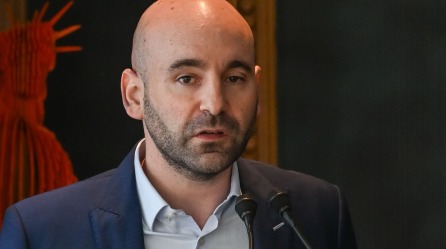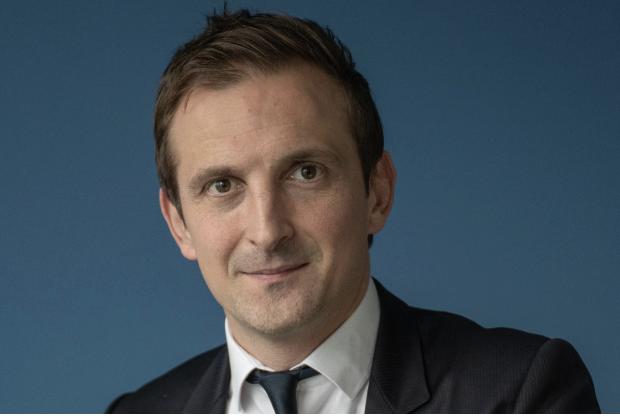
Organized by the Monaco Economic Board (MEB) in partnership with BPMED Monaco, Gramaglia and Coface, the economic conference featuring Jean-Christophe Caffet, Chief Economist at Coface, was held on Tuesday, February 10, at the Novotel Monte-Carlo, ahead of the official presentation of Coface’s Country Risk Colloquium in Paris.
Jean-Christophe Caffet opened his remarks with a deliberately nuanced observation: global growth has stabilised at around 2.8%, slightly above initial expectations.
He attributes this performance to the upward revision of the 2024 figures and the relative robustness of the major economies – from the United States to Japan, Europe and the major emerging countries.
However, this stabilisation should not be interpreted as a return to a calm economic environment. The past year has been marked by a succession of political, economic and geopolitical shocks, illustrating a world that has entered a phase of apparent calm in the eye of the storm. Uncertainty remains at historically high levels, even if it has receded from the peaks observed last spring, particularly after the announcements of US trade policy.
Coface’s analysis highlights a fundamental trend: with each major crisis, the level of global uncertainty reaches a new threshold without ever returning to its previous level, making the economic environment structurally more complex and less predictable for economic actors.
Contrary to popular belief, globalisation is not dead, insisted Coface’s chief economist. International trade in goods and services still accounts for a significant share of global GDP. The stabilisation observed since the great financial crisis is mainly due to the rebalancing of the Chinese growth model and changes in US consumption, rather than a genuine process of deglobalisation.
On the other hand, globalisation is entering a new phase of fragmentation. Trade flows are now being reorganised according to geopolitical blocs, with a marked decline in trade between antagonistic blocs and the rise of so-called ‘connector’ countries, such as Vietnam and Mexico. These countries are playing an increasingly important role as intermediaries in global value chains.
This reconfiguration is not economically neutral: current globalisation now favours securing supply chains at the expense of the sole pursuit of efficiency and low costs. This development implies, in the medium term, less potential growth and more inflationary pressures, with direct consequences for monetary policy.
Another strong message from the conference was that the energy transition is neither complete nor in question, despite the headwinds observed in some countries. The data presented shows that fossil fuels remain largely dominant in the global energy mix, confirming that the road to carbon neutrality is still long.
Beyond environmental considerations, Jean-Christophe Caffet emphasised the major strategic challenge that the energy transition represents for Europe. Without sufficient fossil fuel resources, the European Union has no choice but to accelerate the development of carbon-free energies in order to preserve its strategic autonomy.
The economic argument is just as decisive: renewable energies are now competitive, even without subsidies, with production costs significantly lower than those of fossil fuels in many parts of the world. This reality is reflected in massive and sustained investment by the world’s major energy players.
US trade policy was a central focus of the analysis. While the dramatic announcements of tariff increases fuelled uncertainty, their actual implementation proved to be more nuanced, due to numerous exemptions and corporate adaptation strategies.
Coface’s detailed analysis of the data shows that the impact of tariffs varies greatly from sector to sector. In some cases, foreign exporters absorbed the shock by reducing their margins; in others, where products are difficult to substitute, the increase in tariffs was largely passed on to US consumer prices.
At the macroeconomic level, these policies are helping to keep US inflation above the Federal Reserve’s target, reinforcing the idea of a structurally higher inflation regime than in the past.
The situation in China is one of the main risk factors at the global level. Faced with insufficient domestic demand, the Chinese authorities continue to provide massive support for productive investment, exacerbating industrial overcapacity, particularly in the electric vehicle and energy transition technology sectors.
This strategy is resulting in record trade surpluses and the export of Chinese manufacturing deflation, which is particularly noticeable in Europe. European companies are facing a marked loss of competitiveness, exacerbated by the energy crisis and production cost differentials that have become considerable.
For Coface, this ‘second Chinese shock’ is having a lasting impact on margins, investment and, ultimately, the solvency of European industrial companies.
Unsurprisingly, this environment is leading to an increase in company insolvencies worldwide. The United States is seeing a sharp acceleration, reflecting a catch-up after a period of wait-and-see attitudes and pressure on margins. In Europe and Asia, the trend remains upward, with significant regional disparities.
While some areas show more favourable prospects, others remain under close scrutiny due to fiscal imbalances, financial vulnerabilities or persistent exogenous shocks.
In conclusion, Jean-Christophe Caffet offered a clear-eyed and structured vision of an economic world that has entered a phase of profound restructuring. Growth is holding steady, but vulnerabilities are mounting. For businesses, the challenge is no longer just to anticipate economic cycles, but to navigate an environment that is marked by lasting uncertainty, fragmentation and rising country risks.
In this context, risk analysis, market diversification and securing value chains appear more than ever to be essential strategic levers.
.