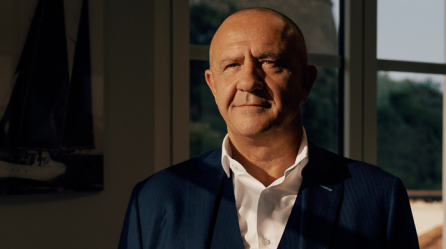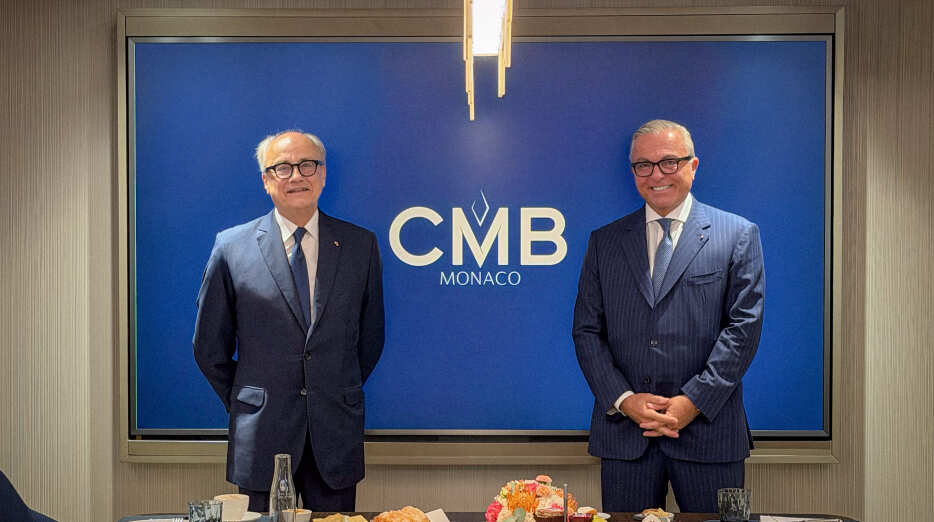
Speaking to journalists, two complementary voices: that of Jean-Luc Biamonti, Chairman of the Board of Directors since last April, and that of Francesco Grosoli, CEO since 2019. The two leaders painted a picture of an institution entering its second half-century with ambition and confidence.
The history of CMB Monaco begins with a unique feature that Francesco Grosoli likes to highlight: it is the only bank in the financial centre to have been established from scratch within the Principality. Established in the spring of 1976, the bank – then known as the Compagnie Monégasque de Banque – began operations on 1 October of the same year, on the initiative of shareholders – foremost among them Banca Commerciale Italiana – who were determined to provide Monaco with an institution with a deeply Monegasque DNA.
Its early decades were those of a generalist bank serving the local economy: providing finance and support to companies, families, entrepreneurs and the State. The turning point came in 1996, when the management of the time made private banking its core business; other institutions would follow suit. Francesco Grosoli sets the scene: in the 1980s, the financial centre’s move upmarket accelerated significantly, alongside the arrival of newcomers choosing Monaco for its quality of life and high level of security. By 2006, CMB had been awarded an A+ rating by Standard & Poor’s.
In 2020, the Compagnie Monégasque de Banque became CMB Monaco. “Pronouncing ‘Compagnie Monégasque de Banque’ wasn’t easy for an English-speaking interlocutor,” smiles the CEO. The bank therefore formalised the acronym that everyone was already using, adding the name of the Principality. This intuition proved to be spot on: during Abu Dhabi Finance Week last December, Francesco Grosoli was able to see this for himself. “As soon as Monaco came up in conversation, the whole dynamic changed completely. The brand is extremely powerful.” Hence the clear commitment to increasingly harness this DNA, which is embedded in the bank’s history as well as in its name.
Having taken up the chairmanship in April, Jean-Luc Biamonti first set about familiarising himself with the firm: meetings with the entire executive committee and with numerous staff members. Well-versed in the international arena, he did not expect to discover an organisation of such calibre; he found “a very high level of technical expertise”. “I was surprised by the calibre of the teams, both individually and in terms of their collective work.” Added to this, in his view, are a keen focus on the client and bespoke service, as well as a high speed of decision-making.
The Chairman describes how it works: whether it concerns management or, even more so, credit, the assessment of an application is carried out in Monaco by teams who know the country and its environment. A decision – whether favourable or not – is reached promptly and communicated to the client without delay. He attributes this high standard to the team put together by Francesco Grosoli since his arrival.
The CEO extends the analysis to the area of investment. The proximity of decision-making centres enables CMB Monaco to make the investments its clients require with particular speed.
CMB Monaco currently has 275 staff spread across four sites and manages just over 20 billion euros in assets, making it one of the Principality’s leading players. “What really interests me is quality and excellence,” explains Francesco Grosoli. “In this business, you only succeed if you understand the client, listen to them and move forward together.”
The bank is backed by a historically very solid balance sheet and equity capital of several hundred million euros, providing clients with ‘peace of mind and confidence’. Since 2019, the trajectory has been clear: assets have roughly doubled, as have revenues, and profits have followed suit. But the CEO places greater emphasis on the fundamental transformation: strategy, services, products and, more recently, technology – “the most important factor today, in any business”.
Francesco Grosoli views the banking sector through the lens of three forms of capital. Firstly, financial capital, which is essential to any bank. Secondly, technological capital, in which CMB has invested heavily. Finally, human capital, “quite simply the most important”: “If we don’t look after it, if the teams don’t work well together, it’s a recipe for failure.”
Whilst CMB Monaco’s transformation has been comprehensive, the last two or three years have been resolutely focused on technology. The bank has replaced its core system – where all client data and transactions are stored – with Avaloq, integrated with Aladdin Wealth, BlackRock’s management platform. In 2025, CMB Monaco thus became the first bank to go live on this integrated platform, and the first European bank to deploy its Auto Commentary feature based on generative AI. Leading-edge tools have been built around this foundation: Salesforce for client relations, and a secure messaging system for communicating with clients. Over the past year, the architecture has been completely overhauled to make data more easily and quickly accessible.
The urgency stems primarily from wealth demographics. Over the next twenty years, some 80,000 billion dollars’ worth of assets will pass from one generation to the next, according to industry estimates. However, the heirs “will not want to interact with private banks in the same way as their parents”. What neobanks have done to retail banking, and what online shopping has done to the retail sector, is now taking hold in private banking: clients, whether young or older, expect a more technology-driven, real-time relationship.
Artificial intelligence has further reshuffled the deck. Over the past six to nine months, notes Francesco Grosoli, its adoption has been meteoric, revolutionising access to information. He gives a striking illustration: some clients now come to meet their bankers after having used artificial intelligence tools to analyse their portfolios…
The conclusion is clear: those players who do not navigate this shift with determination “will fall by the wayside”.
In the CEO’s view, this is the industry’s primary concern. He likes to compare private banking to the luxury goods industry: the clients are the same, but the luxury sector has set standards for service and treatment that the banking sector must now adopt.
The next twelve to eighteen months will be devoted to the roll-out of artificial intelligence. The challenge is less technical than architectural: every piece of software now incorporates its own AI, and the key challenge lies in getting these systems to work in unison towards a single objective – client interaction and coordination between departments that deliver not only quality but also a perceptible difference. The other challenge – perhaps the most significant one – is that of adoption by the staff themselves.
The benefits are already tangible: “We’re doing things faster, better, and above all, we’re channelling staff time into areas where there is added value – for the bank and, first and foremost, for our customers.”
Jean-Luc Biamonti sums it up: CMB Monaco was able to embrace the technology so quickly because the decision was made and implemented swiftly in Monaco. According to Francesco Grosoli, artificial intelligence will create ‘supermen and superwomen’, and he hopes that European governments will recognise the need to teach it from school age onwards. “Society is going to change completely. That is where we are heading. And if we drag our feet, it will be more complicated.”
When asked about data security, Francesco Grosoli is in no mood for complacency: “Cybersecurity is a constant concern for the entire industry.” The bank has deployed significant resources, including a security operations centre that analyses and responds to threats on a daily basis.
Vigilance also depends on the user, as many incidents stem from a moment’s inattention when faced with a phishing attempt. CMB Monaco believes it has an “educational responsibility” and is working to raise awareness amongst its customers.
Faced with “highly sophisticated” organised crime, the bank is constantly working on defences against new fraud techniques, particularly those relying on artificial intelligence, such as voice cloning.
From this technological revolution, CMB Monaco has adopted a slogan: Human Digital Bank. The order of the words is no coincidence. People come first, and must continue to do so. “Having someone face-to-face when a problem arises is not the same as having to resolve it with a chatbot that gives standardised responses.” For customers, that personal touch remains irreplaceable.
The transformation of the teams was initially a qualitative one. As part of a generational renewal, the bank has recruited many young graduates, often from the International University of Monaco, who hold demanding qualifications in investment advice and are developing their careers alongside more experienced colleagues. Each new recruit is supported by a mentor tasked with facilitating their integration into a network of four branches. The bank values merit and encourages early access to managerial responsibilities.
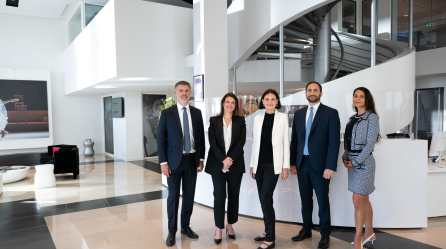
Gender parity is also part of the bank’s identity. Women account for around half of the workforce and, crucially, there is perfect gender parity within the executive committee, with the exception of the CEO himself – a rare occurrence in the financial sector, where female representation dwindles the higher one climbs the hierarchy.
Two months ago, the bank also obtained independent certification for pay equality between women and men (Fair-On-Pay).
What remains essential, however, is what the CEO describes as the ‘spirit of winning together’. He sums it up: ‘When teamwork takes precedence, we do things better, faster, and above all in the best interests of our clients.’
When asked about changes in the client base, Francesco Grosoli points out that Monaco was built on stability, security and openness, which have always attracted people from a wide variety of backgrounds. These are all streams of people who have come to the Principality seeking a temporary refuge, “where the temporary becomes permanent”. He now sees an opportunity in engaging with the Middle East, whose international outlook and entrepreneurial spirit resonate with Monaco’s DNA.
People are quick to talk about Monaco’s wealth; what is often overlooked, the CEO points out, is the intellectual wealth concentrated within two square kilometres: entrepreneurs, scientists and prominent figures from diverse backgrounds, all within a deeply multicultural environment. Some 20,000 millionaires live there without necessarily knowing one another. Bringing this network of exchanges to life is, perhaps, the next frontier for the financial centre.
Francesco Grosoli’s words sum up the spirit of the institution on the eve of its jubilee. Born out of a desire to provide Monaco with a bank of its own, CMB Monaco has successfully reinvented itself with the times – as a generalist bank, a private bank, and then a technology-enhanced wealth management bank – without ever compromising on what defines it: making decisions here, with local teams, for clients from here and further afield. “We are currently preparing the bank for the next fifty years.” Guided by a principle now enshrined in its motto: people first, digital second.