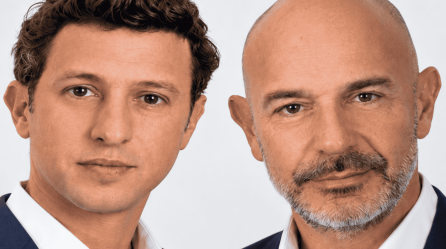
As head of Clean Energy Transition, Per Lekander offers a unique perspective on the changes taking place in the energy sector. From electrification and artificial intelligence to financial markets, this investment specialist analyses the opportunities presented by a global transformation of which we have, as yet, only covered a quarter of the journey.
My decision to move to Monaco was driven primarily by a personal desire – a longing for sunshine. I also believe it is beneficial for a company like ours to have multiple geographical locations. We also have an office in New York, although the bulk of our business remains centred in London, and London is very easily accessible from Monaco.
First, a correction on the premise: this is not a transformation of several decades but of a century. We have developed a framework of 17 indicators across sectors and functions, such as renewable penetration, the share of electricity in heating and in industrial energy demand, and the electrification of trucks, to mention a few. On that measure we are slightly less than a quarter of the way through the energy transition, and the current run rate is around 1% a year, which takes us into the next century before it is complete; our latest estimate is around 2135. Take the figure for what it is, but the order of magnitude matters.
We are living through the third energy transition. The first, in the nineteenth century, was from wood to coal, and it was the foundation of the Industrial Revolution: you could load coal onto a train or a ship and carry far more energy than you ever could with wood. The second was from coal to oil, the foundation of the modern city: goods could be transported into cities, people could travel; it changed everything. The third, the one we are in now, is the electrification of everything: from all other forms of energy to electricity as the main way we use energy, and in parallel we are producing that electricity in an increasingly clean way, partly because of regulation and partly because green sources are simply the lowest cost. That will go on for at least the rest of this century.
Within that, I find it important to separate structural opportunities from cyclical ones, on the long side and on the short side alike. Two further principles guide where I look. The first is that one economic theory works better than all the others, also for estimating earnings and share prices: supply and demand. Wherever a market is supply-constrained, prices and profitability tend to go higher; where demand is weak, the opposite. The second is that market structure and entry barriers are very important and often underestimated, whereas the market tends to overestimate the importance of growth rates. You need growth, but not explosive growth. What is a huge advantage is an industry concentrated in a few players that a new entrant finds hard to break into. What constitutes an entry barrier varies: often it is technology, but it can simply be market share. Many of us are frustrated by Microsoft Word and do not think it is a great product, but when everyone uses it, it is very hard to replace.
The first structural long, which now also has a cyclical upside, is wind. Even if it does not grow like solar, we are talking about double-digit revenue growth, and on top of that a very significant margin recovery. The sector was hit very hard by the inflation shock of 2021-22, in steel above all; that forced a lot of management action and better pricing discipline, and the benefit is now coming through. I can easily see that upside running towards 2030, in cheap stocks with real growth. The market structure helps too: in onshore wind, excluding China, there are three or four players, and in offshore now essentially two, which creates the potential for good profitability. The market, meanwhile, views wind very negatively, which is largely political, “not in my backyard” thinking in several countries, notably the United States.
The second structural long is high-voltage infrastructure. The market is underestimating its duration: we are talking about decades of investment. It moves slowly, because of authorisations and very high capital intensity, but it will provide growth for decades, with plenty of opportunities in both capital goods and electric utilities.
Third, as a very sharp cyclical upturn, driven by AI but also by electricity demand generally, gas turbines. That is well known by now; look at Siemens Energy’s share price. But the market is already trading as if we were at the peak, and that is definitely not my view. I think we will see significant growth well into the 2030s.
Then there are emerging opportunities, where the stocks have not performed yet. One is everything related to housing in the energy transition: insulation, glass, air conditioning, heating systems. Housing has been very weak almost everywhere because of interest rates, so you need some relief on rates, but the companies are improving and valuations are very low. The other is electric vehicles: remarkable growth, but oversupply, mediocre cars and a huge wave of unprofitable Chinese growth have dragged down the whole auto industry. We are not at the inflection point yet, but it will come.
On the negative side, oil and gas has performed very well this year because of two wars, Russia-Ukraine and the Middle East. The day that fades there is a lot of downside: demand is structurally weak, not least because of the electrification of transport, and high prices bring more investment and therefore oversupply. There will be a crash; when depends on the wars. Chemicals is a very difficult space in both the US and Europe, with lower-cost base capacity being added in the Middle East and China against weak demand. And it is too early to take off the shorts in autos. Someone once told me you want to be long the sectors where China is importing, and by the same logic careful about those where China is exporting.
To be clear, we are not investing for the next generation. We are trying to generate relatively consistent returns in the short to medium term, with a typical horizon of around three years. What works over that horizon changes over time, so it is never only about the end game. Looking only at the end game, you could say you should be short oil companies because they may not have a business fifty years from now. But if they make an awful lot of money in the meantime, you will not be in business when that view finally materialises.
A framework I find very useful is what I call rolling back the future. You start with a clear view of the end game and work backwards to how we get there, because the path is rarely linear. Along that path what we are really looking for are revisions and inflection points, because that is what drives stocks in the short to medium term, far more than valuation. Valuation tells you how much upside or downside there is in the long run, but what moves a stock over the next year or two is how things change.
Electric vehicles are a good illustration. It would be very easy to be positive on anything to do with EVs: sales have grown roughly a hundredfold in a decade. That has not stopped the stocks being very poor investments for the last few years. In the early phase you had strong growth and scarcity; scarcity means good margins, good margins mean good profits, and the stocks go up. But good margins also draw in capital, and too much arrived too quickly. Once the early adopters had bought their EVs, demand was still growing, but much more slowly than capacity was being added. Margins contracted and the stocks have been terrible. The end game was right; the path was not linear.
So the discipline is: what does the roadmap say about the long term, and where, over the next few years, could reality surprise the market relative to it? The longs are where the near-term inflection is positive and the market has not seen it; the shorts are where the long-term story is intact but the near-term economics are about to disappoint.
First, a nuance: it is not only about data centres and AI, and it varies by region. In Europe, demand growth comes in roughly three equal tranches: information technology and data centres; electric vehicles, in personal transport and in commercial transport over short and medium distances; and a third, the conversion from thermal to electrical technologies in buildings and in industry. In buildings that means air conditioning spreading across Europe, particularly in the south, and heat pumps replacing gas or oil as the main source of heating in new housing; install an air conditioner in a home and you essentially double its power consumption. In industry it means electrifying processes that used to burn fuel. In the United States it really is more about AI, because EV adoption has been far slower and air conditioning is already universal.
As for the bottlenecks, the important thing to understand is that the main barrier is usually acceptance. It is not innovation and it is not cost; very often the investment is profitable. The barrier is getting permission to do it. Production is a near-term issue but the easier one to solve. The real bottlenecks are networks and permits, and both come back to the same acronym, NIMBY, not in my backyard. You need authorisations, and authorisations require acceptance at many levels, from the individual to the municipality to the state, and you find blockages at every one of them. One startling illustration: the density of wind power in Germany, relative to land area, is around thirty times that of the United States, even though the wind resource is better in the US. Lower US energy prices explain a little of that, but the main reason is barriers to investing at every level of society in most states.
Networks are the biggest of these bottlenecks. The investment is very expensive and very slow; a major transmission line can take decades, and most of that time is authorisation rather than construction. And it is made more pressing by the fact that a renewable system is inherently more volatile, so to make it work you have to interconnect. You simply cannot do it without adding infrastructure on a very significant scale.
I think the cost side is still not well appreciated. Twenty years ago renewables were very expensive and entirely dependent on generous subsidies. I lived in France in the early 2000s and my neighbour installed solar panels; he received a feed-in tariff of around 45 cents per kilowatt-hour for his surplus, seven or eight times the power price of the time.
Things have changed dramatically since, particularly for solar but also for wind. Solar costs have fallen by around 90%, wind by around 50%, and in most regions renewables are now clearly the lowest-cost source, by a wide margin. In Europe, exposed to very high fossil fuel prices, a new gas-fired plant costs something like 150 euros per megawatt-hour fully loaded, against around 60 for onshore wind, 70 to 75 for offshore, and in the region of 40 for solar in the south. That is very deep in the money, and I struggle to see how it reverses. Even in the United States, with extremely low gas prices, renewables tend to be the lowest-cost option: definitely solar, but also wind in the Midwest. So I do not regard a reversal of competitiveness as a credible scenario.
Having said that, a renewable project is a little like a nuclear project: almost all the cost is up front and the operating cost is very low, so anything that raises the upfront cost is a negative, and financing conditions clearly matter. High interest rates are not good for the transition. But you would need a very large change in the economic parameters before it actually slowed things on the ground; probably rates of 7 to 9% before you could even begin to question whether renewables are the lowest-cost source.
Where the factors you list really matter is to share prices. Interest rates work through valuations: the market treats green technologies and networks as bond proxies, so the rise in yields over the past few years has hurt these stocks even though the underlying economics barely changed. Raw materials work through margins, which are always the first to take a hit: if steel or polysilicon prices rise, a company cannot adjust its pricing immediately and may struggle to pass on all of the cost, so margins compress and valuations follow. So the honest answer is that the cost of capital, raw materials and the rest are much more a question of what happens to share prices than of what happens in reality. On the ground, most of these investments are deep in the money, and they stay there.
It is clearly a challenge, and it has two consequences. The first is that you can never go all in on a single idea; you have to run a diversified portfolio. The second is that you sometimes have to actively manage risk, which in practice means being a little more careful than you would have liked to be.
On diversification, our framework is to invest in themes: five to ten ideas at any one time, such as wind margins improving or network investment accelerating. The themes themselves create diversification, and we set upper and lower limits on how large each theme, and each type of stock, can become in the portfolio.
On managing risk, the main tool is trading around positions: when something has performed very well you cut a little, and when something has fallen a lot you add a little. Our own analysis shows that over time this does not necessarily add to performance; often the best thing is to do nothing. But it clearly lowers volatility, and it reduces the risk that in the short term you miss your performance target altogether.
There is a more fundamental point behind this. We are stock analysts, and the job is not to define what a company is worth; it is to have a view on where the stock is going to trade. Hopefully the two are related, but in the short term that relation can be weak. That is the real problem: you can have very strong conviction that a valuation is too low, or too high, and that the market is being irrational, and still be wrong for a long time. It reminds me of the old line that the market can stay irrational longer than the investor can stay solvent. So, given our objective of keeping volatility in check, we may run a position smaller than the fundamentals justify, and scale it up when the stock starts to work. That is a fundamental difference from, say, valuing a company for M&A, where the question really is what the business is worth, because it is not exposed to the daily judgement of public markets.
We also run a separate portfolio, which we call Focus, made up only of our five highest-conviction longs. There we do not manage volatility at all, because the premise is that investors in it are investing for the long term and have accepted that volatility is part of the deal.
For the main fund, when we talk about a 10% net return, we are explicit that it requires a three-year investment horizon. Over rolling three-year periods we have been very stable around that 10%. Over one-year periods it has been far more volatile, and we have reached 10% only around 60% of the time. So the answer comes down to four things: diversification through themes, disciplined risk management, never going all in, and time horizon. Of those, time horizon is the one investors most often underestimate.