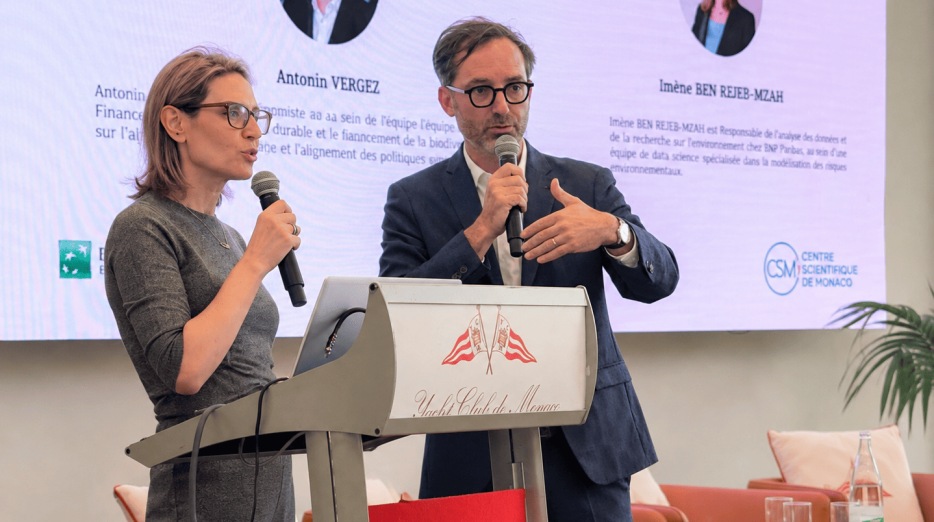
Long regarded as primarily an environmental concern, biodiversity is now emerging as a major economic and financial issue. During a morning event dedicated to the theme ‘Natural capital: biodiversity, a new strategic asset’, organised on 4 November 2026 by BNP Paribas Private Banking at the Monaco Yacht Club, in partnership with the Monaco Scientific Centre, two experts shed further light on the links between nature, value creation and risk management.
An economist at the IUCN (International Union for Conservation of Nature), Antonin Vergez advocates for the economic value of ecosystems to be better integrated into public and private decision-making. This shift requires moving beyond traditional indicators of wealth.
Nature constitutes capital in the same way as physical capital (factories, machinery and industrial infrastructure) and human capital (education, human skills). It constantly provides services that are essential to our economies: the availability and quality of water, soil fertility, pollination, climate regulation and biological resources (timber, fish, etc.). The difficulty lies in the fact that these services are rarely factored into traditional economic indicators. An economy can therefore show GDP growth whilst destroying part of the natural capital on which its future prosperity depends. As a result, even if per capita GDP rises, that society may become poorer.
The Dasgupta Review, published in 2021 at the request of the UK Treasury, illustrates this contradiction. Between 1990 and 2014, capital per capita doubled globally and human capital increased by 14 per cent, whilst natural capital per capita fell by nearly 40 per cent. In other words, we have increased certain forms of wealth whilst degrading another essential component of our common heritage.
The scientific evidence leaves little room for doubt. According to the global assessment published in 2019 by IPBES, 75 per cent of terrestrial habitats and around two-thirds of marine habitats have been significantly altered by human activities. Nearly one million animal and plant species are threatened with extinction. This degradation is not merely an ecological loss. It undermines the ecosystem services on which many economic activities directly depend.
The main causes have been identified: the transformation of natural habitats, overexploitation of resources, pollution, climate change and invasive alien species. The challenge now is to translate this scientific knowledge into economic decisions by private and public sector stakeholders, by incorporating the consequences of nature’s degradation into investment and development strategies.
This is precisely one of the major imbalances we face today. Data presented by the United Nations Environment Programme show that, globally, financial flows associated with activities harmful to nature are around thirty times greater than the funding that contributes to its conservation. [1]
The figures are staggering: around 200 billion dollars a year supports activities that benefit biodiversity, whilst more than 7,000 billion dollars, directly or indirectly, funds activities that have negative impacts on ecosystems. It is therefore not simply a matter of increasing the funding allocated to conservation. We must also redirect existing capital flows, both public and private, so that economic decisions take greater account of the value of natural capital.
The Kunming–Montreal Global Biodiversity Framework, adopted in 2022, sets out, amongst other things, the objective of mobilising at least an additional $200 billion per year by 2030 (Target 19) and reducing financial incentives harmful to biodiversity by $500 billion per year by 2030 (Target 18). Progress has been made, but it is far from sufficient. We need to step up our efforts if we are to achieve these targets.
Tools already exist. The IUCN develops and provides several tools to help us better understand ecosystems, identify key areas for biodiversity and assess the impacts of human activities. The Red List of Threatened Species, the Red List of Ecosystems and the global database on Protected Areas are international scientific benchmarks.
The STAR (Species Threat Abatement and Restoration) metric goes a step further: it enables an assessment of the extent to which reducing certain threats or restoring habitats can help to reduce the risk of species extinction.
The IBAT (Integrated Biodiversity Assessment Tool) platform provides access to this data and enables an assessment of the challenges associated with a particular area or investment.
The ENCORE tool also enables a company, within a given sector, to rapidly assess its main pressures on and dependencies on nature.
Finally, natural capital accounting offers the possibility of describing ecosystems, their condition, the services they provide and certain aspects of their economic value. This is not about claiming to put a price on nature, but about highlighting the value of natural assets and our dependencies, which have so far been insufficiently taken into account.
The challenge is no longer so much to demonstrate that the tools exist as to ensure their widespread use. Financial institutions are gradually gaining access to the data and methods needed to incorporate biodiversity issues into their analyses. However, these tools must actually influence investment decisions, financing policies and risk assessment. The aim is to move from a mindset of knowledge to one of action, by demonstrating that the preservation of natural capital can become a genuine criterion for economic decision-making.
At BNP Paribas, Imène Ben Rejeb-Mzah, Head of Data Analytics and Research on the Environment, works on modelling environmental risks. Her approach highlights the need to link ecological dependencies and the pressures exerted by businesses on nature to their economic and financial consequences.
Because nature represents an invisible production infrastructure on which a large part of the economy depends.
Agriculture, for example, depends on soil quality, water availability and pollination. Industry uses natural and biological resources. The pharmaceutical and cosmetics sectors directly exploit certain resources derived from living organisms. The property and infrastructure sectors also benefit from ecosystem services, particularly in terms of protection against erosion, flooding or heat.
The degradation of these services can therefore directly affect the profitability and business continuity of companies. For a bank, the key issue is to understand how these changes may affect the companies it finances, their value chains and, consequently, the risks associated with its portfolios.
We need to distinguish between two fundamental mechanisms: businesses’ dependence on nature and the pressures they exert on ecosystems.
Let us take a business that is heavily dependent on water. If the ecosystems that ensure the availability or quality of this resource deteriorate, its production costs may rise. It may be forced to adapt its facilities, change its supply chains, or even temporarily suspend its operations. Conversely, a company that exerts significant pressure on biodiversity may face stricter regulations, restrictions on access to certain resources, or changes in demand.
Both these mechanisms can result in a deterioration in financial performance, asset value or repayment capacity.
The challenge for banks is therefore to determine under what circumstances these dependencies and pressures become financially significant.
Climate risk now benefits from a relatively standardised measurement framework, notably thanks to the use of the metric tonne of CO₂ equivalent—which aggregates various greenhouse gases into a single unit—and the development of scenarios linking environmental phenomena to their economic and, subsequently, financial consequences. When it comes to biodiversity, there is no single indicator capable of capturing the full complexity of ecosystems. We must simultaneously take into account species diversity, the state of natural habitats, ecosystem services and, above all, geographical location.
One metric tonne of CO₂ contributes to global warming regardless of where it is emitted. By contrast, pressure on biodiversity can have very different consequences depending on the ecosystem concerned, its initial state and the services it provides. Aggregated indicators can be useful for comparing or prioritising financial exposures. However, they must not obscure the local specificities that determine the reality of the risk.
Several categories of tools are now available.
Location data is a key first step. It enables economic assets to be pinpointed and linked to information on ecosystems, sensitive areas and environmental pressures.
Impact and dependency analysis tools then make it possible to identify the economic activities that are most dependent on certain ecosystem services, as well as those that exert the greatest pressures on nature.
Biodiversity footprint models provide an overview of the pressures exerted by economic activities. In particular, they can help to prioritise exposures within a portfolio.
Finally, forward-looking analyses and scenarios are essential for moving from environmental measurement to a genuine assessment of financial risk.
This involves, for example, examining the economic consequences of a scarcity of natural resources, a regulatory change or an increase in the costs of ecosystem restoration.
The aim is not to simply increase the number of environmental indicators for their own sake. Measurement must serve to better understand the vulnerabilities of the economic system and to inform decisions. This requires bringing together three disciplines that have long evolved separately: ecological science, economic analysis and financial modelling.
The real challenge, therefore, is to move from observed biodiversity to measured biodiversity, and then from quantified risk to financial decision-making.
[1] https://www.unep.org/en/publications/report/state-finance-nature-2026State of Finance for Nature 2026 | UNEP – UN Environment Programme