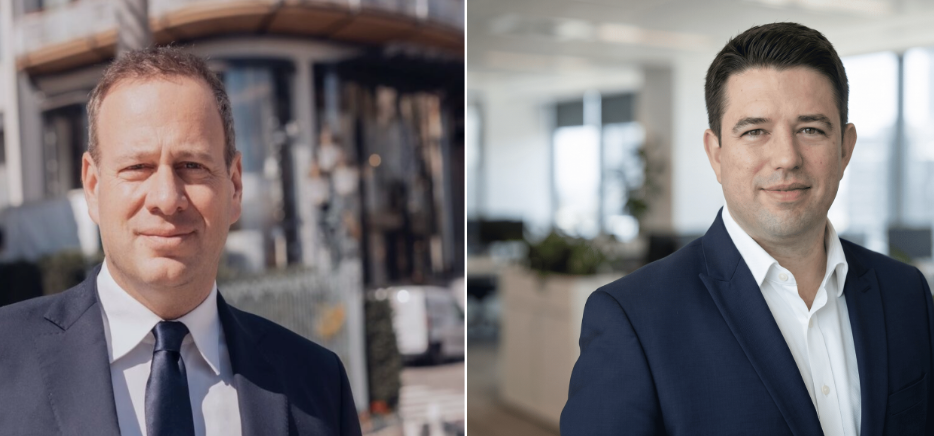
From fraud detection to building multi-scenario portfolios, cybersecurity, and the optimization of internal processes, artificial intelligence is driving a fundamental transformation in the financial sector—one that is irreversible, structural, and heralding a new paradigm for financial markets. Two leading practitioners share their insights: Frédéric Genta, Partner, Head of Europe at Azura Partners and Professor of Finance at ESCP & Sciences Po, and Olivier Pagès, Chief Operating Officer of CMB Monaco.
FREDERIC GENTA
AI is now involved at every level of wealth management—not just in the back office, but at the heart of advisory services. In the back office: automation of procedures, near-real-time detection of fraud and compliance anomalies, and NAV reconciliation. In the front office: cross-referencing client knowledge with massive amounts of market data. For a portfolio manager overseeing a hundred clients with different profiles—risk tolerance, investment horizon, geographic exposure—this represents a tangible transformation. In private transactions, AI simultaneously analyzes internal and external data that no analyst could keep up with manually.
OLIVIER PAGES
Our conviction is simple: AI is not meant to replace the banker, but to support them in their daily work. Quickly analyzing market scenarios, stress-testing a portfolio, standardizing the quality of analysis across teams: the initial use cases are encouraging, even if we remain at a stage where benefits are being built gradually, as teams adopt the technology.
The final decision, however, remains a human one. Always. Behind every portfolio lies a family history, ambitions, and personal convictions that no algorithm will ever fully grasp. Our business is built on relationships, and that will not change.
It is in this spirit that CMB Monaco has become the first bank in the world to jointly deploy Avaloq and BlackRock Aladdin Wealth™—two global industry leaders that we have integrated over the course of eighteen months. We are also the first European bank to use Aladdin AI Commentary, BlackRock’s artificial intelligence module, which enhances portfolio analysis with insights generated from market data.
Internally, we are moving forward methodically. Microsoft Copilot has been available to all our employees for nearly two years. Its uses are gradually expanding—document creation, information summarization, assistance with routine tasks—but adoption varies from one team to another. This is a normal progression with this type of tool: value is built over time, as each person identifies the use cases most relevant to their role.
At the same time, we are evaluating Anthropic’s Claude Enterprise with about fifty employees. Initial feedback suggests significant value for highly analytical tasks—constructing structured reasoning, challenging a hypothesis, or arguing a position—which are central to the work of our operations, risk, and compliance teams. We are continuing this evaluation to better identify the areas where the benefits are most tangible.
We view the two tools as complementary rather than interchangeable: Copilot for the daily productivity of the majority, Claude for analytical depth on certain more demanding tasks. In functions that have historically been very resource-intensive, these tools open up the prospect—to be confirmed over time—of a higher coverage rate than sampling-based monitoring.
FREDERIC GENTA
Both—but in a specific order. AI analyzes, models, and detects. The manager decides, takes responsibility, and explains. This is not a semantic nuance: it is a clear line of accountability.
Traditional management relied on two or three macroeconomic scenarios. AI makes it possible to analyze hundreds simultaneously by incorporating each client’s specific profile. For a client with a particular sensitivity to geopolitical risk and a desire for international diversification, AI builds portfolios tailored to that reality—not to an average. In an unstable environment, limiting oneself to a few core convictions is a risk in itself.
OLIVIER PAGES
At this stage, at CMB, artificial intelligence never intervenes without human validation. The principle of systematic review by an expert remains fundamental. For example, in compliance procedures related to public background checks, AI now allows for the pre-analysis of a very large portion of relevant information. However, final validation always remains the responsibility of specialized teams.
FREDERIC GENTA
Yes—and more profoundly than it appears. For decades, building a portfolio meant choosing a central scenario and sticking to it. That model is no longer suitable. In 2026, several structural forces will simultaneously affect every portfolio: varying adoption of AI, geopolitical realignment, the energy transition, and monetary fragmentation. These forces will combine or contradict one another depending on the company. The goal is no longer to find the right scenario. It is to build resilient allocations across several plausible scenarios simultaneously. This is a paradigm shift.
OLIVIER PAGES
Three non-negotiable principles.
First principle: leading-edge partners. Rather than developing proprietary solutions—tempting on paper, risky in practice—we rely on BlackRock, Avaloq, Microsoft, and Anthropic. These are players with complete transparency toward auditors and regulators, and proven technological robustness.
Second: strict data compartmentalization. Our clients’ information remains within our secure environment. It is never used to train AI models. This is an absolute red line.
Third: formalized governance. Every project undergoes a preliminary risk analysis that incorporates Monegasque and European requirements. Every use case is categorized. Data leak prevention mechanisms are built directly into the interfaces. We leave nothing to chance.
FREDERIC GENTA
There is no such thing as zero risk—neither in AI nor in traditional management. A manager without AI simply has invisible biases. With AI, these biases become visible and manageable. Three principles: do not impose your own convictions on the model—the diversity of sources, including contradictory ones, is non-negotiable. Precisely define the role of AI with clear guidelines. Keep a human in the final decision-making loop: conviction, judgment, and responsibility remain with the manager.
FREDERIC GENTA
The impact can be measured on two levels. On service quality: a manager equipped with AI arrives at a meeting with answers to questions the client hasn’t even asked yet. Morgan Stanley has documented a 40% reduction in advisors’ preparation time, with a direct impact on the quality of interactions.
On performance: the improvement does not come from AI that better predicts the markets. It comes from better risk management and greater resilience. A portfolio built on a hundred scenarios holds up better than one built on three. This isn’t spectacular in the short term. It is decisive over the long term.
OLIVIER PAGES
We are beginning to see effects in certain support functions, particularly in regulatory accounting and management control, where repetitive tasks can be accelerated. It would be premature to draw consolidated figures from this: we are in a learning phase where gains remain varied depending on the teams and use cases. We believe the potential is significant, but it will materialize over time, as practices stabilize and we scale up what works.
OLIVIER PAGES
We have indeed recently appointed an AI manager—a first for a private bank in Monaco, I believe—who brings solid experience gained notably at BlackRock. Rebecca Gibergues’ mission is to structure and steer the bank’s AI roadmap over the coming years. We no longer manage AI on an ad-hoc basis: we steer it with a clear vision, governance, and ambition. This means that AI is no longer just one project among many; it is a strategic priority in its own right, on par with risk management, compliance, or the front office.
OLIVIER PAGES
Cybersecurity is now one of the banking sector’s major challenges. While regulatory compliance remains central, threats are evolving even faster than the frameworks that govern them. Artificial intelligence helps significantly strengthen our analytical capabilities in the face of these threats. Faced with ever-increasing volumes of data, teams alone can no longer process everything effectively.
AI does not replace human expertise, but it enables the filtering, correction, and prioritization of information, allowing weak signals to emerge more quickly. It thus improves the relevance of analyses and allows teams to focus on truly critical incidents. It enables faster detection—sometimes in near real-time—at a scale and with an efficiency that would be difficult to achieve otherwise. This is not a luxury; it has become an indispensable tool.
FREDERIC GENTA
The issue extends beyond any single institution. It is a question of positioning—and for Monaco, a strategic opportunity, provided two pitfalls are avoided.
First pitfall: ignoring the issue in the name of efficiency. Allowing sensitive proprietary data to flow without clear governance undermines the trust that underpins every private wealth management relationship.
Second pitfall: believing that a jurisdiction like Monaco can rebuild everything locally. No one is recreating a major language model in Monaco. The computational power and depth of these models rely on investments of hundreds of billions. Thinking we can do without them is an illusion.
The right approach is a layered one: major international solutions are used for their unmatched power, but client data remains in sovereign, secure environments managed locally. International power, local sovereignty. Monaco has the assets to make this its hallmark—a tradition of confidentiality, manageable size, and a dense institutional fabric. Trust is a financial center’s most valuable asset. Sovereign infrastructure is now the prerequisite for it.
OLIVIER PAGES
Monaco has an asset that few financial centers possess: the ability to make quick decisions, to experiment at scale, and to unite the players within the same center around a common vision. This is a rare strength. The Principality has everything it needs to become a center of excellence for AI applied to finance. Provided it has the ambition to do so.
This requires a collective effort in training. Specialized AI talent is rare and highly sought after. If Monaco wants to attract and retain them, it must invest in dedicated programs and build an educational and professional ecosystem that is up to the task.
Artificial intelligence is not a passing trend. It is a fundamental, irreversible transformation. Financial centers that embrace it with ambition and responsibility will not merely adapt: they will set the rules of the game. Monaco has everything it needs to be part of it.