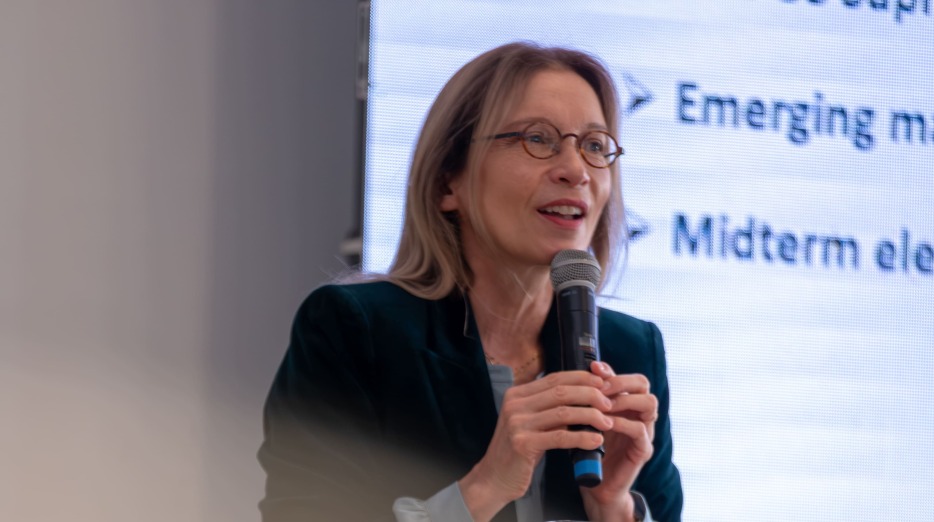
In a world marked by the end of globalisation as we have known it, the global economy is entering a period of profound transition. Mathilde Lemoine, Chief Economist at the Edmond de Rothschild Group, delivered a rigorous and deliberately cautious macroeconomic analysis at the ‘Investment Strategy 2026’ conference in Monaco in January.
We have clearly moved away from a world of globalisation and entered a world of power rivalries. This is a fundamental shift. It means that international economic relations are no longer organised primarily around cost optimisation and competitiveness, but around considerations of sovereignty. This profoundly changes our macroeconomic outlook, because sovereignty automatically implies investment, often on a massive scale, in strategic sectors.
We have identified five major structural conclusions.
The first is the redefinition of the balance of power around the Sino-American axis. The world is now organised into blocs, sometimes in direct opposition, sometimes in circumvention. Trade tensions are not destroying international trade, they are redirecting it.
The second is precisely this reconfiguration of flows. Tariffs have not caused a collapse in global trade, but rather the emergence of new corridors. Mexico has become the United States’ largest trading partner, while several Asian and Eastern European countries are playing an increasing role in trade with China.
The third conclusion concerns sovereignty investment. It affects all sectors: pharmaceuticals, food, cybersecurity, critical technologies and energy. Added to this is military spending, with NATO targets of up to 3.5% of GDP, or even 5% for global defence.
The fourth is the shift in industrial policies: we are moving from competitiveness policies to sovereignty policies. The underlying economic logic is radically different.
Finally, the fifth conclusion is that Europe is still largely suffering from these shocks. It is in a transition phase marked by uncertainty rather than a real recession, but this uncertainty is weighing heavily on the outlook.
The year 2025 has been a positive surprise in terms of global growth. But this resilience is very uneven. We are no longer in a synchronised cycle. The US economy has slowed to 2.1% growth, the eurozone has accelerated slightly, Japan has recovered, while South Korea has slowed sharply. The global economy is evolving in a chaotic, almost disorderly manner.
The same is true for monetary policy. Some central banks have begun cycles of rate cuts, others are pausing, and the Federal Reserve has not yet completed its adjustment. This desynchronisation is an additional source of uncertainty.
Because their impact is neither neutral nor temporary. On average, import tariffs in the United States have risen from around 2.5% to nearly 19%. This is significant. Between 60% and 80% of this increase has been passed on to consumer prices.
Admittedly, the impact has been partially masked by stockpiling effects prior to their implementation. But that does not change the economic reality: these tariffs will weigh on consumption, non-sovereign private investment and confidence.
We have observed empirically that a 10% increase in customs duties leads to a decline of around 10% in exports to the United States. This is a massive effect, particularly for Europe.
Europe is caught in a vice. On the one hand, it is suffering from the increase in US customs duties. On the other, it is facing a massive influx of low-cost Chinese products, a direct consequence of deflation in China and the appreciation of the euro.
European growth is therefore likely to slow down. This situation is all the more complex given that Europe is in a phase of strategic transition, without having yet fully structured its own sovereignty policies on the necessary scale.
We remain cautious. We believe a sharp acceleration in Chinese growth is unlikely. China is facing persistent deflation and its growth is largely based on exports. We anticipate growth of around 4.8%, down from 5% previously, but at the cost of significant imbalances, particularly for its trading partners.
The main supporting factor is global sovereign investment. We have identified, based on facts, nearly $6 trillion in planned spending between now and 2030 on sovereignty policies: defence, energy, technology, cybersecurity and agriculture.
The energy transition, in Europe as in China, is also a form of ‘soft’ sovereignty. Artificial intelligence also plays a central role. In the United States, investment in AI-related infrastructure has already reached nearly $400 billion since 2022. By 2040, AI could generate a cumulative global GDP surplus of more than 10%.
Yes. There is currently a major macroeconomic inconsistency. Real interest rates are exceptionally high, particularly in the United States and Europe. However, high real rates are normally incompatible with a phase of massive investment.
We are faced with a kind of squaring of the circle: a world that requires colossal investment to defend its sovereignty, but with high capital costs and very high political and fiscal uncertainty. In this context, caution is called for. We do not believe in a sharp acceleration in global growth in 2026, unlike some international institutions.