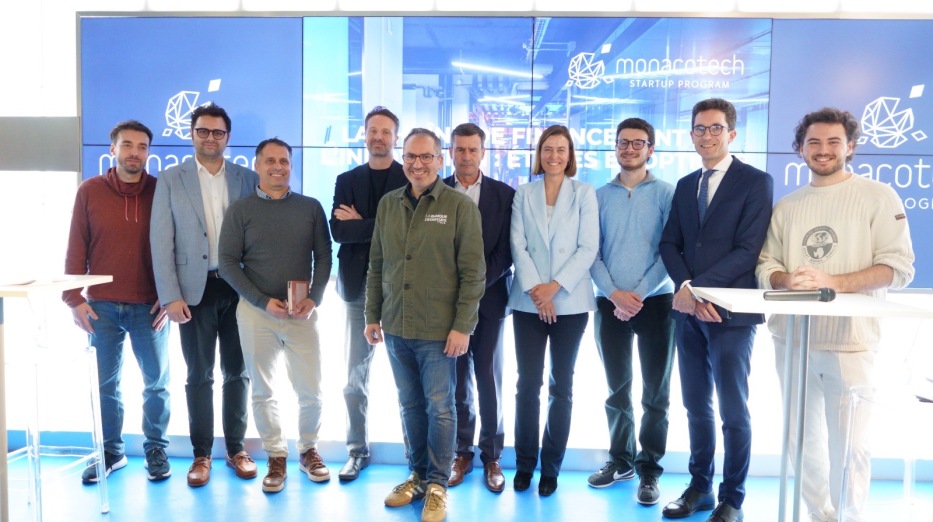
A high-impact support organization at the heart of Monaco’s entrepreneurial ecosystem, MonacoTech selects, supports, and accelerates innovative startups with international potential. Recently invited by the incubator, Fabrice Marsella, director of La Banque des startups by LCL and former architect of Village by CA (Crédit Agricole’s startup accelerator), came to share his analysis of the evolution of the entrepreneurial ecosystem and break down the concrete criteria for successful bank financing in the early stages of development.
I began my career in management consulting, specializing in CRM and, more broadly, innovation. Very early on, I was drawn to the transformations that innovation brings about in practices, organizations, and our way of life. What interests me is how technology helps solve concrete societal challenges.
This guiding principle has stayed with me throughout my professional journey. That’s how I gradually moved toward the entrepreneurial ecosystem, first through innovation-related projects for the Crédit Agricole Group, then through the development of Village by CA, before joining La Banque des startups by LCL today.
What has always driven me is the conviction that innovation is a key driver of economic and societal transformation. I am among those who believe it provides more solutions than it creates problems.
La Banque des startups by LCL is a business division integrated into LCL, but entirely dedicated to the unique challenges faced by young, innovative companies. This specialization is essential, because financing a startup does not follow the same logic as financing an established, profitable company.
A very large proportion of the companies we support are in the seed stage. However, at this stage, approximately 90% of startups are not profitable. This means we cannot analyze their situation using traditional financial analysis criteria based on historical performance.
Bank financing therefore relies on a different logic. Whereas an investor may take a portfolio approach, hoping that one exceptional success will offset several failures, the bank must first and foremost ensure its ability to be repaid. We do not operate according to the law of large numbers. A unicorn does not offset potential losses on other deals. This implies a much more qualitative approach to the company and its leader.
We work in tandem with all financing stakeholders. I often like to use the image of a puzzle: each participant contributes a piece that strengthens the solidity of the whole. Business angels generally step in first, then investment funds take over. The bank fits into this chain by building on the decisions already made by these players, which serve as reassurances. As soon as a piece of the puzzle is missing, the overall balance can become fragile. That’s why the coherence of the financing chain is essential.
The primary determining factor remains the entrepreneur’s profile. We analyze their academic background, professional experience, and network, as well as their ability to embody their project and persuade others. Founders are often highly committed individuals, almost like missionaries, who champion their vision with great intensity. This ability to inspire is essential.
We also examine the quality of the initial investors very carefully. The presence of business angels is an important signal, provided they are genuinely involved in supporting the company. Active investors, capable of opening up their network and advising the entrepreneur, bring a very different value than passive investors who think solely in terms of acceptable losses.
Yes, absolutely. We analyze how key skills are integrated into the project and linked to value creation. For example, if a CTO or a marketing manager plays a pivotal role in the company’s development, it is important to understand how they are involved in the entrepreneurial journey. The involvement of key talent in the equity structure is a factor in the project’s solidity. The quality of the team is a decisive indicator of execution capability.
Yes, very clearly. Support from a recognized organization like MonacoTech is an important reassurance. Experience shows that a supported startup is twice as likely to still be in business five years later than an isolated startup. For a banking institution operating on four- to five-year financing horizons, this difference is significant. It means the company is operating in a supportive environment, surrounded by people whose goal is to foster its success.
It is central. An innovation only makes sense if it meets a real need. We therefore seek to understand the problem the company claims to solve, the depth of the market it targets, and how it positions itself against the competition. When an entrepreneur claims there is no competition, this is generally a red flag: either the market does not yet exist, or there is no demand. The existence of an identified market is an essential prerequisite for the project’s credibility.
We usually get involved after an initial round of fundraising. Our role then is to create leverage that increases the company’s growth capacity over a period of twelve to eighteen months before a new round of fundraising.
The presence of early customers is also a reassuring factor, as it indicates the emergence of a product-market fit. This means the company is no longer merely developing a solution but is beginning to connect with its market.
Financing is merely a means to an end. It is not an end in itself. Our ambition is to position the bank as a partner capable of supporting the entrepreneur on all the structural issues that mark their development trajectory: access to early customers, post-funding structuring, media visibility, understanding dilution mechanisms, anticipating challenges related to artificial intelligence, and preparing for growth stages.
For example, LCL supports a significant portion of French mid-sized companies (ETIs). This provides a considerable lever for facilitating business connections between these companies and startups. Such bridges can very tangibly accelerate the growth of young, innovative companies.
There is still a degree of mutual misunderstanding between entrepreneurs and financial institutions. One of the objectives of my presentation at MonacoTech was precisely to “pop the hood,” so to speak—that is, to explain in concrete terms what reassures a banker and what, on the contrary, can act as a roadblock. Understanding your financial partner’s expectations is essential for building an effective relationship. This also requires banks to develop a better understanding of the new business models driven by startups. That’s why we’ve assembled teams capable of engaging with founders on an equal footing.
I do not want to frame this relationship in transactional terms. If that were the case, an algorithm could do the job just as well, if not better. I deeply believe in building long-term relationships based on trust. The entrepreneurs we support today may become the major companies of tomorrow. When a relationship is built during the most fragile stages of development, it creates a form of lasting loyalty. Beyond the financial aspect, there is also a very strong human dimension. Making a tangible contribution to an entrepreneur’s success is an extremely powerful source of motivation. That is what has driven me forward for over ten years in this ecosystem.