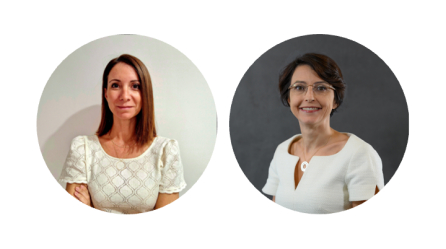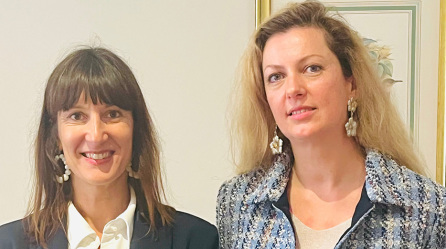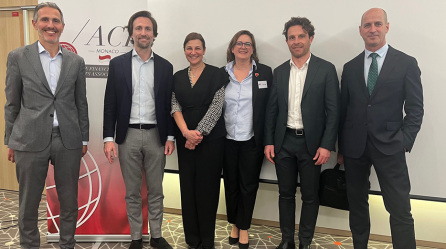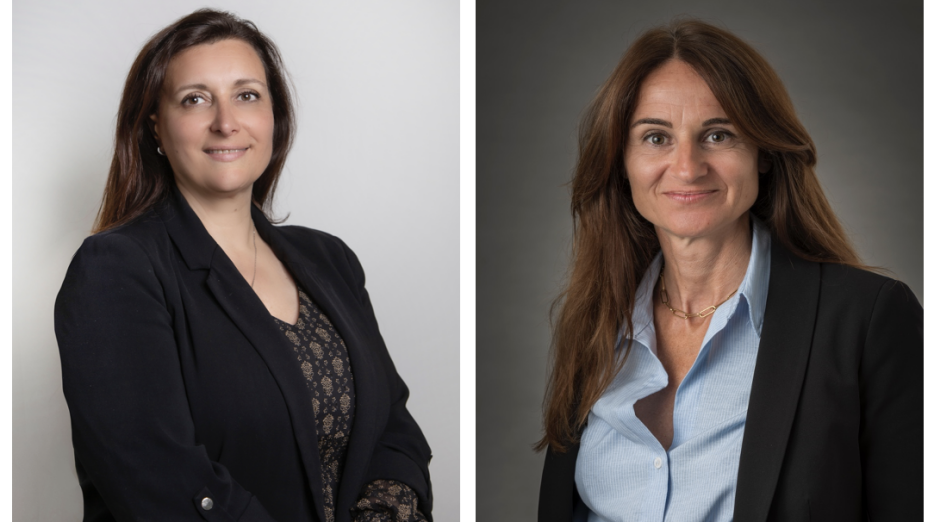
Photo : Misses Sophie ARMANDO et Émilie CHAUVET
To mark International Women’s Day, Monaco for Finance spoke to two leading female executives from Monaco’s financial sector.
Sophie Armando is Deputy Chief Executive Officer of Development and Strategy at CFM Indosuez Wealth Management. Her central role is to place the client at the heart of the strategy, uniting teams around a common ambition for excellence and transformation.
Émilie Chauvet has been Deputy Chief Executive Officer of Société Générale Private Banking Monaco since 2023. She embodies a new generation of female leaders in finance, striving to balance performance, rigorous governance and human values.
They share a demanding and committed vision of management, performance and professional equality. Two different career paths, but the same conviction: sustainable success is based on trust, diversity of talent and collective responsibility.
Sophie Armando
My role as Deputy Chief Executive Officer for Development and Strategy is to put the client at the centre of all our thinking and actions. I ensure that every strategic direction, every development project and every innovation initiative is guided by the ambition to offer an excellent, personalised and sustainable client experience.
Throughout my career, I have been committed to serving our customers, whether they are individuals, entrepreneurs or institutions. My various experiences, both operational and strategic, have enabled me to develop expertise in tailor-made support, complex project management and change management, always with customer satisfaction as my guiding principle.
Today, I am committed to uniting teams around this same commitment to quality service and attentiveness, convinced that the success of our organisation depends above all on the trust and loyalty of our clients.
Émilie Chauvet
My mission is both strategic and human. Human first, because our business is based on trust. We support clients and their families in structuring their wealth over the long term, sometimes over several generations. This requires understanding their history, their inheritance and governance issues. In this context, the quality of the relationship is essential: it is our real capital.
But my role is also strategic. As Deputy Chief Executive Officer, I must ensure a framework of excellence: solid governance, rigorous risk management and exemplary compliance. It is also about setting a clear course and ambition, and putting the teams in the best possible position to ensure that our client promise is based on a reliable and demanding foundation.
Sophie Armando
I have always been attracted to financial services because of their central role in the economy and their ability to support major transformation challenges, whether in terms of innovation, sustainable development or helping clients to achieve their projects. It is a demanding sector in direct contact with the real economy, constantly evolving, where agility and anticipation are essential to meet the expectations of an increasingly sophisticated and international clientele.
Beyond my interest in the sector, I was motivated by the prospect of taking on managerial responsibilities.
Being a manager is above all about bringing people together, supporting the development of teams’ expertise and instilling a collective dynamic around a common project. It also involves promoting a vision, steering change and ensuring excellence for the client. This dual commitment, to performance and to people, is fully in line with my values and my professional ambition.
Émilie Chauvet
What motivated me was the desire to put my expertise at the service of a collective. Management allows you to move away from a logic of individual performance to support a shared ambition. I have always believed that the role of a manager is to create the conditions for others to succeed. This requires a clear framework, transparent communication, accountability and recognition.
In finance, management takes on a special dimension: the decisions we make affect our clients. This requires ethics, rigour and a deep respect for the teams. Customer excellence relies on trained, committed and confident employees. This is the foundation I seek to build on.
Sophie Armando
I believe that leadership style is above all a reflection of each person’s personality, background and convictions, regardless of gender. Management approaches are shaped by experience, training, corporate culture and personal values.
What makes an organisation rich is the diversity of profiles and points of view, far beyond gender issues. The key is to allow everyone to express their leadership in an authentic and effective way, in the service of collective performance and team development.
Sophie Armando
Monaco has evolved considerably in recent years in terms of diversity and women’s access to positions of responsibility in finance. Although certain obstacles may remain, as in many financial centres, I see a real desire for openness and progress.
Attitudes are changing, and more and more women now hold management positions or participate in governance bodies. Of course, there are still steps to be taken, but I am convinced that collective commitment and the promotion of talent, whatever its form, will continue to break down barriers.
The key is to continue our efforts to offer everyone, women and men alike, the same opportunities for professional development and fulfilment. As proof of this, CFM Indosuez Wealth Management appointed a Chief Executive Officer on 1 October, Bénédicte Chrétien, and I myself was appointed Deputy Chief Executive Officer for Development and Strategy on 2 January.
Émilie Chauvet
I don’t think Monaco is particularly unique in this regard. However, as elsewhere, there are fewer women as you move up the corporate ladder.
I firmly believe that promotions should be based on expertise, not gender. That said, we must recognise that certain systemic barriers remain. In Monaco, we have chosen to adopt a proactive policy. Today, 42% of our Executive Committee are women, and 45% of our managers are women. These figures show that change is possible.
Sophie Armando
That’s a crucial question. Encouraging women to be more daring is important, but it shouldn’t obscure the need to change the system as a whole. It would be simplistic to think that career advancement depends solely on individual boldness; it is just as crucial for organisations to actively commit to ensuring equal opportunities.
As leaders, I believe it is our responsibility to identify and promote opportunities for advancement for all employees, regardless of gender. This means implementing objective evaluation processes, promoting diversity in career paths and creating an environment where everyone can express their potential.
Individual boldness and collective commitment must go hand in hand: it is by combining these two levers that we will be able to bring about lasting change in attitudes and offer everyone, women and men alike, the same opportunities for fulfilment and advancement.
Émilie Chauvet
It is useful to tell women to be bold, because I still see forms of self-censorship today. But that would not be enough if the system itself does not change.
The rules of the game must be made clearer and fairer. We must offer equal access to high-stakes assignments, make promotion criteria transparent, and actively promote diversity. There is also a very concrete lever: sponsorship. Having allies, people who trust you, make you visible and recommend you. I have been fortunate enough to have this, and I try to pass it on in turn.
I want to convey a message of optimism and vigilance. Optimism because attitudes are changing, career paths are diversifying, and women are advancing. Vigilance because nothing can ever be taken for granted and we must continue to use all the levers at our disposal to advance professional equality.
We must believe in the collective. Sustainable performance is based on diversity, responsibility and trust. This is the model I defend every day.