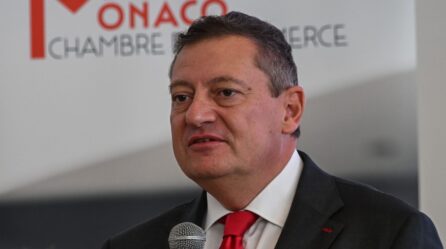
Vice President and CEO of the Prince Albert II of Monaco Foundation since last March, after serving as its Executive Director and Secretary General since 2019, Romain Ciarlet holds a firm conviction: protecting the ocean is no longer just a matter of philanthropy, but also requires the structured mobilization of private capital. An in-depth interview.
We organized the Blue Economy and Finance Forum (BEFF) at the request of the French and Costa Rican authorities, who were co-hosting the United Nations Ocean Conference in Nice and wanted to include an official segment dedicated to the issue of the blue economy and finance. The Foundation has been extremely active on this topic for several years.
This edition was a resounding success. It allowed us to count on the participation of heads of state—President Macron, the President of Costa Rica—as well as public figures such as Prince William of England. The central focus was the blue economy and finance: we brought together private-sector decision-makers, leaders of major international companies active across various sectors of the blue economy, and, above all, private and institutional investors. We succeeded in mobilizing €8.7 billion in commitments by 2030 to support blue economy and finance initiatives. This is a substantial amount and will translate into very concrete outcomes: investments in renewable energy, in decarbonizing the maritime sector, and in more sustainable food systems.
We have Prince Albert II’s approval to make this an annual event. However, the format will change significantly. We will no longer be affiliated with the United Nations Ocean Conference; we are refocusing the event on the private sector. We will concentrate our efforts on mobilizing investors: family offices, institutional investors, pension funds, sovereign wealth funds, and endowment funds of major universities. We want to attract the players who hold the capital and can truly make a difference. We are aiming for approximately 400 participants, including 25% asset owners—family offices and institutional investors; 25% decision-makers from major international companies active in tourism, the maritime sector, banking and finance, and the food industry; and 50% representing the innovation ecosystem and existing investment solutions.
We will thus move from a first edition that was highly public and political to a second one that is more concrete and financial.
The Foundation is entirely dedicated to environmental protection, and we operate through three complementary approaches: philanthropy, advocacy, and impact investing.
The top priority is to strengthen our conservation efforts. We aim to protect and restore ecosystems that are essential for combating climate change, protecting biodiversity, and tackling sources of pollution.
In particular, we will expand our work in the Mediterranean: we have a network of extremely strong partners and significant influence throughout the Mediterranean region. We will continue to develop and manage marine protected areas, as well as combat plastic pollution and protect endangered species.
Our second priority is to remain a strong driving force in advocacy. We are the only Foundation chaired by a sitting Head of State, and we work hand in hand with Monegasque diplomacy. We have achieved major successes by contributing to the publication of an IPCC report from the perspective of marine sovereignty and we have been very active regarding the treaty on the high seas—the so-called BBNJ treaty—which must now be implemented. Over the next five years, our advocacy priority will focus on the polar regions, which are essential for the climate but completely marginalized in major international debates. Our goal is to promote scientific knowledge and bring it to the level of multilateral diplomacy.
The third priority ties in with what I mentioned regarding the Blue Economy and Finance Forum. The Foundation is deeply involved in blue economy and finance issues. We must preserve and amplify this momentum. The BEFF is the central vehicle for this, but we have also developed investment solutions in partnership with asset managers—notably Monaco Asset Management—through the flagship initiative known as the ReOcean Fund.
The ReOcean Fund is the Foundation’s flagship initiativeIt is a private equity fund that we launched in partnership with Monaco Asset Management as a pure joint venture. Its goal: to raise 100 million eurosTo date, we have raised 70 million euros and are on track to reach our target by the end of the year. These 100 million euros will be invested in 15 to 20 companies that are accelerating the transition to a more sustainable blue economy.
The thematic scope we address is broad: solutions to tackle plastic pollution, decarbonization of the maritime sector, innovation in the food sector—sustainable fishing, sustainable aquaculture—uses of artificial intelligence to accelerate sectoral transitions, and the protection or restoration of marine ecosystems.
The fund does not invest in startups. We target scale-ups—companies with a proven track record, generating at least €10 million in revenue, on a clear path to profitability, and in need of capital to scale up. We estimate that there are more than 3,000 companies positioned to capitalize on the innovation momentum surrounding the ocean. To date, the fund has made three investments, and we expect to announce a fourth in the coming weeks. Our goal is to deploy the entire fund over the next four years, at a pace of three to four investments per year. The return we promise our investors is a 20% IRR.
Yes, the Blue Economy Index, created in partnership with Oddo BHF. It is a basket of 30 publicly traded stocks, all with very strong ESG scores. These companies operate across various sectors of the blue economy: water treatment, waste management, shipping, and aquaculture. A portion of the management fees is donated to philanthropic projects, thereby creating a virtuous cycle.
I would like to emphasize that this index is an index in the strict sense. All banks are free to structure products around itcapital-guaranteed products, certificates, and socially responsible structured products. We have already collaborated with Edmond de Rothschild Bank to create such a product, and we are in ongoing discussions with several other financial institutions. In the current geopolitical context, this is a particularly popular product, as the underlying assets—water treatment, waste treatment—are defensive, stable assets deeply rooted in local communities.
Yes, the perception that it involves a sacrificial approach, where it is assumed that the investor must compromise their return on investment to make an impact. This is a common misconception that does not hold true in practice.
Take the example of renewable energy: in the current context of geopolitical and energy tensions, and in the face of the rise of artificial intelligence—which significantly increases energy needs—renewable energy represents an attractive investment theme, perfectly aligned with sustainable development goals and climate imperatives.
These opportunities can be found in many other sectors: maritime, food, and tourism. We manage assets that we invest in a manner aligned with our purpose, and we find that with sound strategies and a deep understanding of the market, it is not necessary to compromise profitability for the sake of impact.
Regulatory requirements are driving financial institutions toward ESG. This is positive, but change must occur both in terms of client appetite and within the institutions themselves.
It is absolutely essential to distinguish between these two activities. They share the same ethics and the same ultimate goal—impact[ —but they are two different fields.
For philanthropy, we raise funds and donate them to finance research and conservation. We receive hundreds of applications every year. A dedicated team of scientists reviews them and selects the most relevant and promising projects in terms of impact. These projects are then submitted to a high-level scientific and technical committee, composed of globally recognized experts, who provide their opinion. Finally, our board of directors makes the final decision. In terms of philanthropy, we allocate approximately €8 million in grants annually, which represents a substantial amount: this allows us to fund activities that lack their own business model—research, conservation, and public awareness—and that rely on philanthropy or public funding to exist. We thus support, between those operated directly by the Foundation and others led by third-party organizations, about twenty projects per year.
The goal of impact investing is to create a scale effect. We encourage investment in the blue economy to generate a net impact that can, in the long run, far exceed what philanthropy—as necessary as it is—can achieve on its own. Regarding the Re Ocean fund, a dedicated investment team identifies and analyzes opportunities. An impact committee and an investment committee then make the decisions.
The annual investment level ranges from 15 to 20 million euros per year, based on three to four investments.
Of course, one of our most telling investments is in a Spanish company called Bound4Blue. It produces rigid sails installed on very large ships. By installing these systems, fuel consumption on these ships can be reduced by an average of 20%, and thus their greenhouse gas emissions by 20%.
When we invested in this company, it had installed its systems on thirteen ships. Today, it has a program of 47 vessels. If we assume that this level of cost reduction is confirmed on a large scale, the impact on the shipping sector—which is among the world’s largest emitters of CO2—could be significant. This is what real impact investing is all about: an impact that extends far beyond the scope of a single project and can become truly transformative over the medium to long term.
Absolutely. This exemplary approach is highly motivating for other stakeholders, because we need billions—not hundreds of millions—to truly make a difference on a global scale. If we can convince sovereign wealth funds in the Middle East, as well as prominent American or Asian families, to launch similar initiatives—because it makes economic sense and because you can make money while doing good—the volume of capital flowing into the sector could increase tenfold or twentyfold. That is the second lever of this initiative.
The most significant obstacle is the perception people may have of environmental issues. If we looked at our short- and long-term interests in a balanced way, we would understand that the cost of inaction is far greater than the cost of immediate action. The challenge is to make impact-related themes more attractive to investors; ultimately, this becomes a cultural issue.
We also suffer from the persistent confusion between philanthropy and investment. Many of the stakeholders we approach are not convinced of the economic value of these initiatives and equate them with charitable efforts. We must convince them that the economic bet is justified. If we manage both to deploy capital and deliver the promised return, we will have demonstrated that impact and economic performance are compatible, which can have a ripple effect far beyond our fund alone.
There is also a political obstacle, which is more prominent today than it was a few years ago. But we have observed, in our discussions with numerous corporations, families, and institutional investors, that those who are truly committed remain so. They are well aware that the challenges of climate change, biodiversity, and pollution are certainly the greatest challengesof our generation. They tend to look beyond the immediate political context.