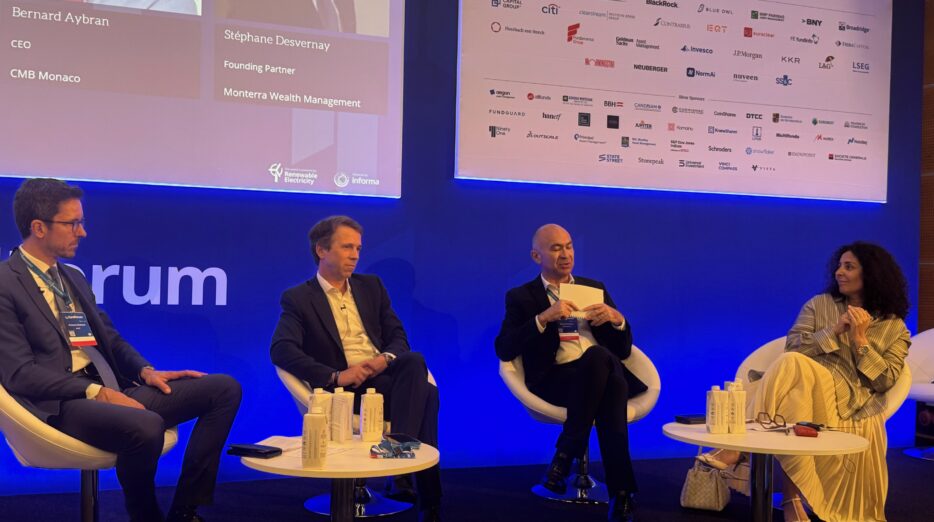
At the 2026 International Fund Forum, one of the world’s largest asset management events, Amaury Chaboud, Secretary General of the AMAF, brought together a panel of three executives from Monaco’s financial center: Sérène El Masri, CEO of UBP Monaco; Bernard Aybran, CEO of CMG Monaco; and Stéphane Desvernay, CIO of Monterra Wealth Management.
Sérène El Masri: Indeed. Two years after being placed under enhanced monitoring, Monaco has reached a major milestone. The FATF determined that the Principality had largely completed the implementation of the action plan adopted in June 2024. No measures are now pending. A visit by the assessors is expected shortly, a step generally considered a prerequisite for removal from the gray list.
This recognition is the result of a remarkable collective effort involving the Government, the National Council, the AMSF, the judicial authorities, regulated professions, and all financial institutions. Monaco is even ahead of schedule in implementing the sixth European Anti-Money Laundering Directive. This demonstrates the Principality’s ability to mobilize quickly to meet the most demanding international standards.
Stéphane Desvernay: Monaco remains a unique case. More than 38,000 residents representing over 140 nationalities live within just two square kilometers. Per capita GDP stands at approximately 270,000 euros, the government has no public debt, and annual revenue exceeds two billion euros. Beyond the numbers, it is above all the institutional continuity that is impressive. More than 700 years of uninterrupted history have helped build a stable, predictable, and secure environment. These factors are now a powerful draw for international entrepreneurs and prominent families with significant wealth.
Bernard Aybran: Momentum remains particularly strong. As of the end of 2025, Monaco had nearly 100 licensed financial institutions, including 74 asset management firms. The 24 banks operating in the Principality managed nearly 183 billion euros in assets, while outstanding loans exceeded 31 billion euros.
This growth reflects not only the financial center’s appeal but also its ability to continually expand its offerings. Expertise is growing, particularly in the management of foreign-domiciled funds, including hedge funds. Other B2B activities, such as brokerage, are also experiencing sustained growth. At the same time, we are seeing a steady increase in the number of high-net-worth clients, who are contributing significantly to the overall rise in assets under management.
Sérène El Masri: What characterizes Monaco is the combination of quality of life, stability, and international openness.
The population settling in the Principality today is evolving. Alongside long-time residents, we are welcoming more and more entrepreneurs who have already achieved success in their home countries and wish to continue their businesses from Monaco. The Monegasque ecosystem naturally fosters exchanges and opportunities. A fun example is the Monaco Grand Prix: more than half of the Formula 1 drivers now live in the Principality. This perfectly illustrates the territory’s international appeal.
Stéphane Desvernay: Clients are younger, more international, and often still very active professionally. Their needs have become considerably more sophisticated. They are seeking solutions less tied to traditional markets and are increasingly interested in alternative assets. Private equity is now a major trend and can account for up to 20% of certain portfolios, depending on risk profiles. We are also seeing a marked resurgence of hedge funds as well as growing interest in structured products, which offer diversification solutions tailored to more complex market environments.
Bernard Aybran: Two major transformations are underway. The first concerns products. More and more institutions are managing funds locally, whether under Monegasque or foreign law. This trend now affects the entire market. The second concerns the integration of artificial intelligence into internal processes. Institutions are investing heavily in digitalization to improve the customer experience, operational efficiency, and security.
Sérène El Masri: AI is already being used in many areas. Know-Your-Customer (KYC) procedures are becoming more streamlined thanks to “Smart KYC” solutions. Credit risk analyses are also being optimized through automated scoring systems. This helps speed up certain decisions while maintaining high standards. We are witnessing the beginning of a true revolution in the use of data. Banks and asset management firms are paying particular attention to these issues. MonacoTech also plays a vital role by supporting fintech companies and fostering innovation within Monaco’s financial ecosystem.
Serene El Masri: Due to the stability of its institutions, Monaco is often recognized as a safe-haven financial center. It attracts nationals from countries in conflict, as well as—for other reasons—certain wealth managers and intermediaries from the United Kingdom.
Stéphane Desvernay: Proximity. In an area of just two square kilometers, clients, banks, asset management firms, and authorities interact on a daily basis. This proximity fosters rapid decision-making, personalized solutions, and ongoing dialogue between public and private sector stakeholders.
Bernard Aybran: This proximity is also reflected in client relationships. In Monaco, it’s not uncommon to meet with an important client on a holiday if the situation calls for it. This availability is part of the financial center’s DNA.