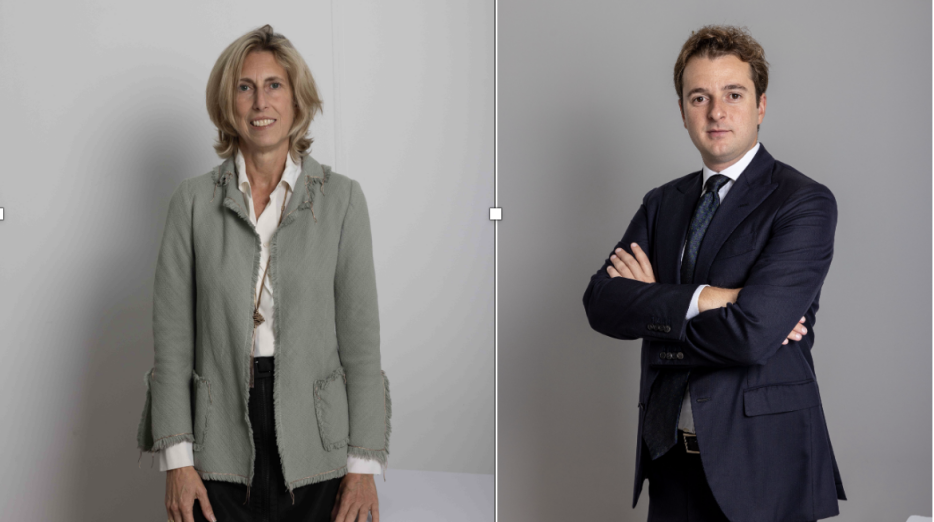
With more than 25 years of track record in European activist investing, SSVL Monaco[1] has developed a highly specialised approach focused on undervalued small and mid-cap companies. In this interview, Giulia Nobili, Chairman of SSVL Monaco, and Beniamino Sciacca, Managing Director at SSVL Monaco, explain how the firm combines deep industrial analysis, constructive shareholder engagement and disciplined capital allocation to generate long-term value across European markets.
Giulia Nobili:
SSVL has more than 25 years of track record. The business was originally created by Tito Tettamanti, a Swiss entrepreneur who identified the opportunity in activist investing. The original fund was launched in 1999 and was initially available to a very selected group of like-minded investors.
Massimo Pedrazzini and I have been involved with the fund for more than twenty years. Over time, we realised that activist investing in the European small and mid-cap segment represented a particularly attractive and successful niche. In 2016, we decided to transform the original structure into a fully regulated Luxembourg SICAV. Since the founder and main investor was already operating from Monaco through his family office, it became natural to establish the investment adviser in Monaco while keeping the fund domiciled in Luxembourg.
For the past ten years, we have evolved from a family-office structure into a professional, fully regulated investment platform while maintaining a very consistent investment philosophy.
Giulia Nobili:
Our strategy is based on a long-only concentrated portfolio of listed European small and mid-cap companies. We focus primarily on the UK, Switzerland, Germany, Benelux, and the Nordic countries. Typically, we take significant minority stakes between 3% and 15%, with a 2-4-year investment horizon.
What differentiates us is that we target companies with a strong underlying business and competitive position, but that are facing specific issues that we believe can be addressed through active engagement as minority shareholders. These issues typically include weak management execution and strategic decisions, poor governance, sub-optimal corporate structure, or capital allocation decisions.
Our approach is much closer to an industrial analysis than a purely financial one. We conduct in-depth research, meet with management teams and boards, speak extensively with other shareholders, competitors, experts, and attend industry trade fairs. Our aim is to build a deep understanding of the business and create consensus among stakeholders in order to promote constructive change.
Giulia Nobili:
We strongly believe in “behind-the-scenes” activism. We rarely go public unless it becomes absolutely necessary. With small and mid-cap companies, aggressive public campaigns can quickly trigger defensive reactions from management teams. Our philosophy is therefore based on constructive dialogue.
We want companies to understand that we have done the work, that we know the business in depth, and that our objective is aligned with the creation of long-term value for all shareholders.
In many ways, our process resembles private equity because of the depth of the operational analysis we perform. However, unlike private equity, we operate in listed markets and retain the flexibility to trade throughout the life of the investment.
Giulia Nobili:
The first fund was closed in 2021 and generated annualised unlevered returns of 9.6% since its inception in 1999.
The current Sterling Active Fund, launched in October 2020, has generated annualised unlevered returns above 11%. Year-to-date performance currently stands at approximately +12.5%, despite a particularly volatile macroeconomic and geopolitical environment.
Giulia Nobili:
We have developed a very extensive proprietary database across the main European markets, in addition to an extensive network of experts, managers, financial institutions, and other investors. We systematically screen for undervalued companies where we see at least 50% upside potential.
Importantly, we only invest where we believe we can genuinely contribute to value creation as minority investors. That is why the small and mid-cap segment is particularly attractive: many situations are overlooked by larger institutional investors, creating opportunities for specialised and engaged shareholders like us.
Giulia Nobili:
Our strategy requires extremely detailed local knowledge. We need to engage directly with management teams, boards and shareholders, which means understanding corporate cultures, governance frameworks and market practices very deeply.
Within Europe, we also focus on markets where corporate governance standards are particularly advanced.
Giulia Nobili:
Not necessarily. We generally prefer to recommend independent industry experts rather than occupy board seats ourselves. This also allows us to preserve trading flexibility.
For example, in one UK-listed specialty chemicals company, we supported the appointment of a highly experienced industry veteran to the board. Sector expertise is often far more valuable than financial expertise alone.
That said, in certain situations we do join boards directly. I personally sit on the board of one of our portfolio companies based in Sweden, where we are the largest shareholder with approximately 14% ownership. In highly involved situations, direct participation can become necessary.
Beniamino Sciacca:
A very good recent example is Senior plc, a UK-listed engineering group with a strong exposure to aerospace and defence. Its core business designs and manufactures fluid conveyance and thermal management systems – IP-protected, mission-critical components used across demanding industrial applications.
When we first invested, the market viewed Senior as a small, complex and underperforming industrial conglomerate. However, our analysis suggested that the consolidated numbers were hiding the quality of the core business and that the company had reached an inflection point.
The investment thesis combined three elements: an expected multi-year upcycle in its key end-markets, a meaningful margin recovery, and the disposal of the lower-quality, non-core Aerostructures division. That disposal would expose the underlying quality of the remaining business and, in our view, could turn the resulting pure-play into an attractive takeover target.
Beniamino Sciacca:
The case unfolded as anticipated. After extensive engagement with management, the Board, and other key shareholders, Senior announced the sale of Aerostructures in July 2025. The remaining, higher-quality business then began to re-rate progressively.
As anticipated, the streamlined company quickly became an attractive acquisition target. Following multiple unsolicited approaches, Senior received a firm offer from the Blackstone/Tinicum consortium in April 2026 to acquire the company at 300 pence per share. We initially invested at around 150 pence per share. Following the firm offer, Sterling Active Fund decided to fully exit its position by selling its remaining shares through the market.
For the Fund, Senior stands as one of the most rewarding outcomes of recent years. This case perfectly illustrates our philosophy: identifying hidden value, engaging constructively to unlock it, and creating alignment between operational improvements, governance and shareholder interests.
Giulia Nobili:
Dislocation and volatility create opportunities, particularly in the small and mid-cap universe. These companies often require engaged shareholders capable of understanding businesses in depth and supporting strategic transformation.
Our edge comes from combining rigorous industrial analysis, long-term engagement and disciplined capital allocation. We remain highly selective, concentrated and conservative in our use of risk, while maintaining a very active role in value creation.