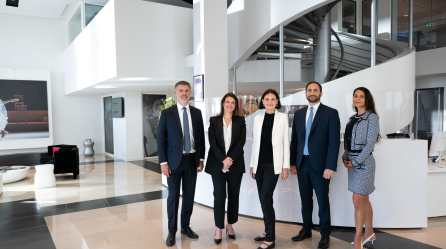
Moderated by Ludivine Garnaud, events editor-in-chief at L’AGEFI, this roundtable brought together Renaud Bottaro, head of the Private Banking division at LCL Banque Privée Monaco, Émilie Chauvet, Deputy Head of Société Générale Private Banking Monaco, Matteo Mescolini, CEO of EFG Bank Monaco, and Thibaut Mortelecq, director of development at Altaroc Partners. The discussions highlighted the now indispensable role of private equity in private investors’ portfolios, its role in wealth diversification, and the new opportunities offered by major economic transformations. All participants emphasized the need for a long-term approach, grounded in education, the selection of fund managers, and the quality of client support.
Long reserved for institutional investors, private equity has become a structural component of the asset allocations of the most sophisticated clients. This trend is particularly pronounced among high-net-worth individuals, entrepreneurs, and family offices, who are seeking new sources of returns while diversifying their portfolios.
Émilie Chauvet observes that unlisted assets now occupy a significant place in investment allocations. Depending on the investor’s profile, they can account for between 15% and 30% of financial assets, and even more when investors possess specialized expertise or are advised by single-family offices. For her, private equity constitutes the core of private assets, around which private debt and infrastructure investments are built. “Historically, this asset class has delivered the most value creation,” she emphasizes. This trend also reflects investors’ desire for more direct access to the real economy and to growth drivers often absent from public markets.
At LCL Banque Privée Monaco, Renaud Bottaro also observes a steady rise in the presence of private equity within portfolios. While average allocations remain between 5% and 10%, some clients allocate well over 30%. Conversely, a portion of the client base is still discovering this asset class. This democratization stems as much from the economic context as from the evolution of the solutions offered. Volatility in public markets and geopolitical tensions have led many investors to seek out more decorrelated assets. At the same time, the emergence of evergreen funds has helped make private equity more accessible.
Renaud Bottaro also points out that these investments address a growing desire among clients: to give meaning to their wealth and help finance the real economy. Private equity thus makes it possible to tell a story and support companies, regions, or sectors that drive growth.
For Matteo Mescolini, CEO of EFG Bank Monaco, the appeal of private equity lies in particular in its ability to capture a significant portion of value creation before companies go public. He points out that in the United States, only a small proportion of companies with more than $100 million in revenue are publicly traded. A large portion of growth is therefore generated outside traditional financial markets. This reality explains the growing role of private markets in the strategies of high-net-worth individuals and entrepreneurs. “
“Private equity allows investors to capture a significant portion of the real economy’s growth before it reaches public markets,” he explains.
At EFG Bank Monaco, entrepreneurs naturally constitute a clientele that is particularly receptive to this approach, as they themselves are familiar with starting businesses and long-term horizons.
The speakers emphasized that recent geopolitical developments are gradually reshaping the themes favored by investors.
Émilie Chauvet observes a growing interest in sovereignty issues, whether related to European defense, healthcare, cloud computing, digital infrastructure, or data management.
Artificial intelligence is also a major cross-cutting theme. Beyond technology companies themselves, opportunities exist across all sectors capable of integrating these new tools into their operational processes.
Renaud Bottaro also highlights strategies focused on mature, growing companies—primarily European ones—that are capable of navigating major economic shifts.
Europe retains a privileged position in many investment allocations, even though the United States remains essential for certain specialized segments.
For Matteo Mescolini, building a private equity portfolio must always be part of a long-term vision. Major economic trends take precedence over passing fads. In particular, he believes that issues related to the environmental transition, technology, and the blue economy will continue to shape investment opportunities in the coming decades. “When you’re investing over a ten-year horizon, you have to think very far ahead,” he summarizes. This approach also explains the importance placed on geographic and sectoral diversification.
Thibaut Mortelecq, Director of Development at Altaroc Partners, noted that a private equity portfolio is built over several economic cycles.
He warns against the temptation to follow the most hyped themes of the moment. “We’re very careful about fads,” he explains. Defense, ESG, or artificial intelligence can naturally present opportunities, but they must fit within a coherent ten-year strategy. Altaroc therefore prioritizes sectors such as software, business services, healthcare, and companies capable of becoming international leaders. Emphasis is also placed on small- and mid-cap companies, which are considered to generate more value over the long term.
All panelists emphasized the critical importance of selecting the right management teams.
For Émilie Chauvet, the analysis criteria focus as much on historical performance as on the managers’ operational ability to support companies in their growth.
The contribution is no longer limited to capital. It also involves providing skills, sector expertise, and genuine strategic added value.
Renaud Bottaro, for his part, highlights the importance of aligning the interests of managers and investors, as well as the need to analyze performance dispersion among different management firms.
Thibaut Mortelecq pays particular attention to team stability, the distribution of capital within management firms, and preparing for generational succession. In his view, the human qualities of the teams are often an even more important factor than past performance.
Matteo Mescolini shares this conviction. “Private equity is, above all, a people business,” he notes.
The democratization of private equity requires a considerable educational effort. Fund raises, distributions, taxation, investment horizons, and the gradual building of portfolios: these are all topics that require specific guidance. The professionals in attendance emphasized that this educational aspect now represents a significant part of their work. The most experienced investors seek ever more in-depth analyses, while new entrants need guidance in understanding this asset class. This educational mission is undoubtedly one of the major challenges for the future development of private equity.
At the conclusion of the discussions, a consensus emerged: private equity will continue to gain importance in the portfolios of private investors.
The growing sophistication of investment solutions, the gradual opening of private markets, and the major economic shifts currently underway are reinforcing interest in this asset class. For Renaud Bottaro, Émilie Chauvet, and Matteo Mescolini, this evolution is part of a fundamental trend that goes far beyond cyclical effects. However, they all emphasize that private equity remains a demanding investment that requires time, discipline, and rigorous selection—qualities that, more than ever, make the difference in an environment that has become more complex and selective.